Showing posts sorted by relevance for query Outsider test for faith. Sort by date Show all posts

October 16, 2012

Blurbs for My Book "The Outsider Test for Faith"

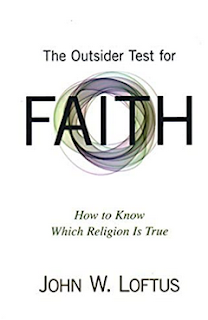
Here are the blurbs for my book The Outsider Test for Faith: How to Know Which Religion Is True (OTF) in no particular order:
-------------

Formulating and extensively defending the OTF is Loftus’ greatest contribution to the philosophy of religion and atheism. The basic idea is that you can only have a rational faith if you test it by the same standards you apply to all other competing faiths; yet when you do that, your religion tests as false as the others, and the same reasons you use to reject those become equally valid reasons to reject yours.

This is the greatest book Loftus has ever produced. It's without question a must-read for believers, and atheists who wants to debate them. Superbly argued, air tight, and endlessly useful, this should be everyone's first stop in the god debate. Loftus meets every objection and proves the Outsider Test for Faith is really the core of every case against religious belief, and the one argument you can't honestly get around. It takes religion on at its most basic presuppositions, forcing the believer into a dilemma from which there is no escape: either abandon your faith or admit you don't believe in being logically consistent. After reading it, and sincerely applying its principles, anyone who really wants to be rational will be on the road to atheism in no time.

Though this idea has been voiced before, Loftus is the first to name it, rigorize it, and give it an extensive philosophical defense; moreover, by doing so, he is the first to cause a concerted apologetic to arise attempting to dodge it, to which he could then respond. The end result is one of the most effective and powerful arguments for atheism there is. It is, in effect, a covering argument that subsumes all other arguments for atheism into a common framework. http://freethoughtblogs.com/carrier/archives/2981/

 -- Dr. Richard Carrier, author of Why I Am Not a Christian: Four Conclusive Reasons to Reject the Faith.

 -------------

John Loftus's Outsider Test for Faith is well-written; it is passionate; it is important; it is engaging; and it is surprising. It's well worth the relatively short read and a lot of consideration. It's a silver-bullet argument on its central theme: which religion is true? None of them! Get it; read it; and press the OTF out into the world where it can do some good. I strongly recommend it for anyone interested in discussions about religious faith.

For the believers this book presents itself as a test for determining which religion is true. Specifically, it sets out to engage readers on the question of the distribution of world faiths, asking them to look at their faith as would an outsider. This removes the double standard and allows believers their one shot at strengthening their faith-based claims in an increasingly secular world. Every believer today owes it to himself or herself, as well as to his or her faith community, to engage Loftus's arguments openly and honestly. It is a total game-changer.

  --Dr. James A. Lindsay, Author of  Everybody Is Wrong About God.

 -------------

 John Loftus will be remembered a century from now for his Outsider Test for Faith.

 -- Frank Zindler, former president of America Atheists and editor of American Atheist Magazine.

 -------------

The Outsider Test for Faith should earn Loftus a permanent place in the history of critiques of religion.

 -- Christopher Hallquist, author of UFOs, Ghosts, and a Rising God: Debunking the Resurrection of Jesus.

 -------------

Without doubt one of the best books I've ever read on faith. A masterpiece.

 -- Dr. Peter Boghossian, author of A Manual for Creating Atheists.

 -------------

John Loftus has done it again! He has produced a lucid and exhaustive explanation of the simple proposition that individuals should examine their own faith with the same skepticism they show toward the claims of other faiths. No significant objection is left unexamined, and no major objector escapes unscathed. This is a potent antidote to those who elevate faith above reason, and superstition above science. It is a bravura performance.

 -- Dr. Hector Avalos, author of The End of Biblical Studies.

 -------------

I am a big fan of John Loftus’s “Outsider Test for Faith”-the view that because one’s religious faith is almost completely an accident of birth, believers should be highly skeptical about whether their own faith is correct. The wisdom of this rational and quasi-scientific approach is unquestionable. But if it's used honestly, its outcome is inevitable.

 -- Dr. Jerry A. Coyne, Professor of Ecology and Evolution at The University of Chicago and author of Faith Versus Fact: Why Science and Religions Are Incompatible.

 -------------

Loftus makes a convincing case that believers who are willing to honestly apply the outsider test cannot but fail to see the irrationality of their faith.

 -- Victor J. Stenger, author of God and the Folly of Faith.

 -------------

Over the past ten thousand years there have been tens of thousands of religions and thousands of gods. Which one is the right one? To believers in each one they all appear unique. To an anthropologist from Mars they all look the same. . . . John W. Loftus’s clever Outsider Test for Faith gives you the intellectual firepower you need when engaging believers, pointing out, for example, that they are religious skeptics, too—of all those other faiths. Some of us go one faith further in our skepticism. You will, too, after reading this testament to the power of reason.

 -- Dr. Michael Shermer, publisher of Skeptic magazine, and author of The Believing Brain.

 -------------

The Outsider Test for Faith is an ingenious way of helping the religious take a step back so that they can fairly and impartially examine what they believe, which can only be a good thing.

 -- Dr. Stephen Law, senior lecturer in philosophy, University of London, and author of Believing Bullshit.

 -------------

John Loftus has written a bold book based on a simple premise: The unexamined faith is not worth believing. Of course, every Christian apologist gives lip service to this premise and claims to have given the tenets of faith a full and fair hearing. Loftus shows just how cheap and hollow such talk usually is. He demands that believers examine their own faith with all of the rigor and skepticism that they direct towards other faiths. To those who condemn the beliefs of others while elevating their own dogmas, Loftus’ message could come straight from the Gospel: Remove the beam from your own eye before you seek to remove the speck from another’s.

 -- Dr. Keith Parsons, PhD, Professor of Philosophy, University of Houston-Clear Lake; author of books in the philosophy of science, history of science, and philosophy of religion.

 -------------

Perhaps the most intractable argument against Loftus’s outsider test of faith is some version of “I can’t do it. I can’t get far enough outside of my emotions and beliefs to examine my own religion like I would any other.” As a psychologist I find that credible. We all have a very imperfect and fragmentary ability to see ourselves as others see us. But this in no way undermines Loftus’s foundational argument that the outsider test should be the gold standard.

 -- Dr. Valerie Tarico, psychologist and author of Trusting Doubt.

 --------------

When an evangelical minister can ask tough questions about religion and leave the faith, then so can you. John Loftus is the religious believer’s genuine friend, respecting your intelligence enough to show you how religions really work. His new book questions every religion with the same challenge: what reasons could it really have for claiming to possesses the unique truth? When the façades of familiarity and unquestionability are ripped away, exposing faith’s weaknesses to both insiders and outsiders, can any religion pass this test?

 -- Dr. John Shook, PhD, Center for Inquiry and American Humanist Association and author of The God Debates.

 -------------

This is an excellent exposition of a relatively obvious argument. The OTF is intuitively simple. The multitude of religions require explaining, from a theistic point of view, and until adequate answer is given, skeptical agnosticism is the most reasonable position. That is common-sense. Loftus takes this idea and thoroughly defends it in a fully convincing and very readable manner.  

 I wasn't expecting to like this book as much as I did because I thought that the argument was simple and obvious, but the way Loftus drew in quotes and arguments from a plethora of different sources meant that this book packs a really hefty punch and left me thinking, on many, many pages, that I must remember this quote or that quote.

 I think this book deserves to be very widely read as the argument seems not to have any significant counters.

 --Johnathan Pearce, an Amazon review, author of many books including The Resurrection: A Critical Examination of the Easter Story.

  -------------

Loftus Brings the Hammer Down! Simply one of the most powerful books I have ever read. I was stunned as on page after page his sensibility, his logic, and his obvious way of finding out what the real and true religion is, is literally shunned by all religions! Loftus has very well written his very finest with this one. Profoundly influential thinking. Detailed rebuttals of those lying Christians who love to pretend they have taken the test and passed it. Not a chance, and Loftus demonstrates step by step exactly why. The problem is faith, the most problematic concept in all of religion, and Loftus absolutely demonstrates with beautiful detail. What a powerful book! READ IT. Faith lacks the power to discriminate between true and false, as all the various thousands of Christian denominations demonstrate for us all to see with our own eyes. All use faith for their own views and condemn all others, who also use faith for *their* own views, and no one has a clue. Not a pea-pickin clue at all! Loftus shreds faith and demonstrates that reality is never confirmed by mere possibility, but only through probability. A most stimulating and powerful book! It was so doggone good when I finished it, I immediately started over and re-read it again. And I will do so yet again soon as well.

 --Kerry Shirts, an Amazon review. 

To say I'm excited is an understatement of gargantuan propositions.

March 22, 2022

Does The Outsider Test for Faith Unfairly Target Religion?

Here is the final section from chapter 8 of my book The Outsider Test for Faith (pp. 169-170). I summarize what is wrong with objections that the OTF unfairly targets religion.

My Response to All These Objections

Let’s just respond to all of these objections this way: Either the OTF is a fair way to assess the truth of religious faiths or it is not. If it is not a fair test, per the above objections, then why do believers use it to reasonably examine the religious faiths of others? That they do is clearly evident. When believers criticize the faiths they reject, they use reason and science to do so. They assume these other religions have the burden of proof when it comes to their extraordinary claims of miracles. They assume that their holy book(s) are written by human not divine authors. They assume a human not a divine origin of their faiths. Believers do this when rejecting other faiths. So this dispenses with all the red herrings about ethics, politics, science, and a material universe, for the OTF simply asks believers to do unto their own faith what they already do unto other faiths. All it asks of them is to be consistent. If there is any inconsistency at all, it is in how they assess truth claims. But if the OTF is a fair test, why do believers have a double standard, one for their own religious faith and a different standard for the religious faiths they reject? Let them use reason and science to examine their own faith. Let them assume their own faith has the burden of proof when it comes to their extraordinary claims of miracles. Let them assume human rather than divine authors of their holy book(s).

July 02, 2010

The Outsider Test For Faith

[Written by John W. Loftus] Below you'll find a fairly extensive list of links to the Outsider Test for Faith for anyone who wishes to learn about it. You'll see how my defenses of the OTF have been improved with time as I received various criticisms of it. There is a lot to read here.

No wonder I've decided to write a whole book about it!

The book supersedes and supplants everything I've written about it in the links below.

December 14, 2017

The First Few Pages From "The Outsider Test for Faith"

There's a great deal of misunderstanding about my book, The Outsider Test for Faith: How to Know Which Religion Is True (OTF). Look at the subtitle. It's proposing a test to know which religion is true. With the proliferation of a diversity of religions and sects what can be wrong with providing an objective test to know which one is true, if there is one? Nothing. Nothing I can see. Nothing at all. If you don't like this test propose a different one. My hunch is it'll look exactly like this one, if it's both reasonable and based on sufficient objective evidence. It's unbelievable that most believers object to it, or eviscerate its power to get at the truth. The reason must be they instinctively know their faith won't pass the test. THAT should say something significant! They should come out in droves to embrace it instead. That would get our attention. But they don't. The OTF allows no double standards. It requires sufficient objective evidence. It requires shouldering the burden of proof. No wonder believers don't like it, since all they have is fallacious reasoning based in special pleading, gross mischaracterization, a boatload of non-sequiturs, red-herrings, begging the question at every crucial juncture, and so much more. Herer are a few high recommendations of it.

March 27, 2022

On The Fundamental Objection to the OTF

[Republished post from 3/03/ 2012]
In a very well-written comment EricRC, a Ph.D. student in philosophy with promise, sums up what he calls the fundamental objection to the Outsider Test for Faith (OTF). Before sharing and then critiquing what he wrote let me refresh my readers on what it is:

December 21, 2022

The Outsider Test for Faith: How To Know Which Religion is True


I'm done writing and editing books, so I'm highlighting each one of them in thirteen separate posts.

I had wanted the subtitle to be "How to Know Which Religion Is True If There Is One, since I don't think there is one. But that was rejected by my publisher for some ignorant reason I forget now.

Most of my books were conceived and tested on this blog in debates with believers. This is the case with this book more than any other. Here's the Amazon link to my book. In it I'm arguing for a fair test to help believers examine their own faith honestly, without any special pleading or double standards. I am arguing that every honest seeker should embrace it. This should be seen in the first few pages of my book. While I think the test leads to unbelief, that's a separate debate.

February 03, 2025

Rapoport's Rules Meet the Outsider Test

Rapoport’s Rules for Debate

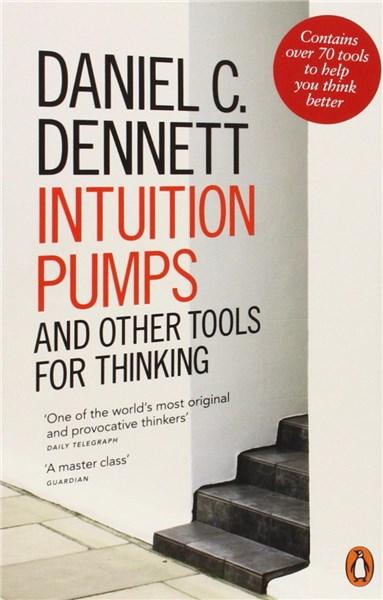
Intuition Pumps cover imageAccording to the English Wikipedia, Daniel Dennett (March 28, 1942 – April 19, 2024) “was an American philosopher and cognitive scientist. His research centered on the philosophy of mind, the philosophy of science, and the philosophy of biology, particularly as those fields relate to evolutionary biology and cognitive science.” Dennett was and remains well-known in atheist/freethinking/skeptical circles as one of the so-called “Four Horsemen” of New Atheism, alongside Richard Dawkins, Christopher Hitchens, and Sam Harris.

In this post I draw from Chapter 3 of Dennett’s book Intuition Pumps and Other Tools for Thinking (2013). The particular intuition pump, or tool in that chapter is what Dennett called “Rapoport’s Rules for Debate”. The Rules are Dennett’s suggestion for how to disagree with someone productively. In this article I’ll explore the practicality of the rules, and how one might apply them to John W. Loftus’ Outsider Test for Faith.

Dennett’s version of Rapoport’s Rules attracted considerable commentary, as this DDG Web search shows. Quoting from Dennett’s original version: 

November 14, 2019

Dr. Matthew Flannagan Opposes Known Facts Requiring the OTF

Ladies and gentlemen, I humbly submit to you more in the case study of Dr. Matt Flannagan's view of the The Outsider Test for Faith. Here's an example of what cognitive biases do to someone's brain when rejecting the requirement for sufficient objective evidence. He's digging his heels in deeper and deeper into the muddy waters of his faith bias. [See Tag for earlier entries].

This exchange took place on Facebook. I had posted pictures of the Christian apologetics books I own and Flannagan commented.

Flannagan: I am pretty confident that during my education: through secular public school, a public university known for leftist leanings and activism and a secular philosophy department. I studied, read and listened to more atheists and secularists than the average atheist has to Christians. I certainly have read more atheists philosophers than any atheists I know has read Christians.

I had to pounce!

Loftus: You had me up until the bold claim of your last sentence. I think you may know of one such atheist. Even if what you claim is true, it only shows that cognitive biases run wild within your brain. I know this from your review of the outsider test for faith.

The goal of the OTF is to help indoctrinated people to require sufficient objective evidence for their own faith, just as they require it for the faiths they reject. You failed to properly object to the OTF because your brain wouldn't allow you to understand it. LINK.

July 17, 2019

Dr. Chris Gadsden Obfuscates On The Outsider Test for Faith

Dr. Chris Gadsden
I must admit it's kind of gratifying when Christian philosophers take a look at the Outsider Test for Faith (OTF), which I've defended online and in my book. Recently Dr. Chris Gadsden decided to look at it. He has earned two master’s degrees and one PhD in philosophy (University of Missouri). He appears to be some sort of expert on proper belief formation, as seen in his PhD dissertation, Epistemic duties and blameworthiness for belief. He also appears as the kind of guy who doesn't hunker down in the trenches willing to die rather than admit he might be wrong about something. We'll see, because he begins with a misunderstanding by saying, "Lots of internet atheists promote the 'outsider test' (OTF) as a potent weapon against Christians. But how potent is it? Let’s have a look."

October 17, 2008

Posts of Mine That Further Defend the Arguments in my Book.

If you've gotten my book and want to learn more about a few of the topics I've recently defended since publication, here they are:

Is Atheism Rationally Coercive?

The Changing Face of Apologetics: I Agree with Lee Strobel.

The Historian and the Resurrection.

The Golden Rule: A Parallel Analogy to the Outsider Test for Faith.

Don't Be Fooled on April Fool's Day: Take the Outsider Test for Faith.

Answering Reppert's Objections to the Outsider Test for Faith.

The Outsider Test for Faith

Fitting the Pieces Together, the Christian Puzzle is Solved!

What Can Account for Morality?

Why I'm Doing What I'm Doing

Testing Religious Experiences by the Outsider Test for Faith

Christianity Fails the Insider Test for Faith Too!

The Flat Earth, the Firmament, and the Three Storied Hebrew Universe.

Another Failed Christian Attempt to Explain Away Suffering: Mary Jo Sharp's Review of the 2nd Loftus/Wood Debate.

Psalm 137 is a Genocidal Passage.

How Not to Argue Against Me.

On Presuppositions, Assumptions, Worldviews and Control Beliefs.

A Critique of Craig's Use of Hilbert's Hotel

Intense Suffering is An Internal Problem for the Christian.

Did I Reject Christianity Solely Because of My Experiences?

Christianity is Wildly Improbable to Me.

William Lane Craig on the Content of the Inner Witness of the Holy Spirit.

William Lane Craig is an Epistemological Solipsist.

William Lane Craig is an Epistemological Solipsist, Revisited.

If Bill Craig Knew What he Does Now He Never Would’ve Accepted Christianity.

A Critique of John F. Haught’s book, God and the New Atheism.

I Believe Jesus was a Historical Person.

I Believe Jesus was a Historical Person, part 2.

I Believe Jesus was a Historical Person, part 3.

A Three Man Debate on the Existence of Jesus.

Christian, What is the Basis of Your Faith?.

Is Religion the Root of All Evil?

I Never Said I Couldn't Come to Reasonable Conclusions About History.

Does Catholicism Fare Any Better Than Evangelicalism?

Was Atheism the Cause of 20th Century Atrocities?

September 05, 2012

Give Drs. Rauser and Marshall a Big Welcome!

Christian apologists Drs. Randal Rauser and David Marshal seem to have conspired together to comment here as a tag team in a wrestling match against me at DC. Why? Because I have "a big audience," said Rauser in a comment, an audience of atheists, agnostics and skeptics. And so it seems with Marshall as well. Give them a big warm DC welcome. No, seriously, I welcome them. Now I don't want to be over-run with Christian apologists, but I suppose they will be met with more atheists who want to debate them over the issues that divide us. So I would welcome this too. Just be careful when it comes to my involvement. Don't assume that if they have the last word that I cannot answer them, and don't expect me to have the time to answer them either, since I now have a second job (I had told my readers this might be necessary for a long time, and the time has come. I'm tired of living on a meager income). I'd like to say some additional things about this development, if it's something that will continue into the future (and of this I don't know).

March 20, 2009

The Outsider Test for Faith

[Written by John W. Loftus] Here's an edited version of my Outsider Test for Faith chapter, which I read to the Evangelical Philosophical Society. My book fleshes it out much better and responds to all known objections:

THE OUTSIDER TEST FOR FAITH
by John W. Loftus

The most important question of all when it comes to assessing the truth claims of Christian theism is whether we should approach the available evidence through the eyes of faith, or of skepticism. Complete neutrality, while desirable, seems to be practically impossible, since the worldview we use to evaluate the evidence is already there prior to looking at the evidence. So the question I’ll be addressing today is whether we should adopt a believing or a skeptical predisposition prior to examining the evidence for a religious set of beliefs. I’ll argue that a skeptical predisposition is the preferred one to adopt.

My Outsider Test for Faith (OTF) is just one of several arguments I use to demonstrate that when examining the evidence for a religious set of beliefs the predisposition of skepticism is warranted. There is overwhelming, undeniable and non-controversial evidence for the test itself that can be found in the sociological, anthropological, and psychological data. I’ll start with some of this data that forms the basis for the test. Then I’ll describe the test, provide some examples of what it demands of the believer, and defend it from six major objections.

There is a great deal of discussion among Christian apologists over Bayesian “background factors,” which play a significant role in assessing the truth of Christianity in general, the likelihood of the resurrection of Jesus, the probability of miracles, and the problem of evil. But the most important background factor of all for cognitively assessing the truth claims of religious faith is one’s sociological and cultural background.

The basis for the outsider test has been stated adequately by liberal Christian philosopher John Hick: “It is evident that in some ninety-nine percent of the cases the religion which an individual professes and to which he or she adheres depends upon the accidents of birth.” That is to say, if we were born in Saudi Arabia, we would be Sunni Muslims right now. If we were born in Iran, we’d be Shi’a Muslims. If we were born in India, we’d be a Hindus. If we were born in Japan, we’d be Shintoists. If we were born in Mongolia, we’d be Buddhists. If we were born in the first century BCE in Israel, we’d adhere to the Jewish faith at that time, and if we were born in Europe in 1000 CE, we’d be Roman Catholics. For the first nine hundred years we would’ve believed in the ransom theory of Jesus’ atonement. As Christians during the later Middle Ages, we wouldn’t have seen anything wrong with killing witches, torturing heretics, and conquering Jerusalem from the “infidels” in the Crusades. These things are as close to being undeniable facts as we can get in the sociological world.

Had we lived in ancient Egypt or Babylon, we would’ve been very superstitious and polytheistic to the core. In the ancient world, we would’ve sought divine guidance through divination, tried to alter circumstances through magic, and believed in the dreaded evil eye.

There are a whole range of issues that admit of diversity in the moral and political areas as well, based to an overwhelming degree on the “accidents of birth.” Caucasian American men would’ve believed with President Andrew Jackson in manifest destiny, our God-given mandate to seize Native American territories in westward expansion. Up through the seventeenth century we would’ve believed that women were intellectually inferior to men, and consequently we wouldn’t have allowed them to become educated in the same subjects as men, much less to vote. Like Thomas Jefferson and most Americans, we would’ve thought this way about black people as well, that they were intellectually inferior to whites, while if we were born in the South, we would’ve justified slavery from the Bible. If in today’s world we were born in the Palestinian Gaza strip, we would hate the Jews and probably want to kill them all.

These kinds of moral, political, and religious beliefs, based upon cultural conditions, can be duplicated into a lengthy list of beliefs that we would’ve had if we were born in a different time and place. Voltaire was right: “Every man is a creature of the age in which he lives, and few are able to raise themselves above the ideas of their time.”

Social conditions provide us with the initial control beliefs we use from that moment on to incorporate all known facts and experiences. That’s why they’re called control beliefs. They are somewhat like blinders. From the moment we put them on, we pretty much see only what our blinders will let us see, because reason is mostly used to serve them.

Michael Shermer, a former Christian turned atheist, has done an extensive study of why people believe in God and in “weird things.” He argues: “Most of us most of the time come to our beliefs for a variety of reasons having little to do with empirical evidence and logical reasoning. Rather, such variables as genetic predispositions, parental predilections, sibling influences, peer pressures, educational experiences, and life impressions all shape the personality preferences and emotional inclinations that, in conjunction with numerous social and cultural influences, lead us to make certain belief choices. Rarely do any of us sit down before a table of facts, weigh them pro and con, and choose the most logical and rational belief, regardless of what we previously believed. Instead, the facts of the world come to us through the colored filters of the theories, hypotheses, hunches, biases, and prejudices we have accumulated through our lifetime. We then sort through the body of data and select those most confirming what we already believe, and ignore or rationalize away those that are disconfirming. All of us do this, of course, but smart people are better at it.”

Christian philosopher Robert McKim concurs in some respects. He wrote: “We seem to have a remarkable capacity to find arguments that support positions which we antecedently hold. Reason is, to a great extent, the slave of prior commitments.” Hence the whole notion of “an independent rational judgment” is suspect, he claims. This is not to deny that Christian apologists defend their faith with reasons. Of course they do. These apologists, if they’re good at what they do, will be smart people. But as Michael Shermer also reminds us, “smart people, because they are more intelligent and better educated, are able to give intellectual reasons justifying their beliefs that they arrived at for nonintelligent reasons.”

Psychiatrist Dr. Valerie Tarico describes the process of defending unintelligent beliefs by smart people. She claims, “it doesn’t take very many false assumptions to send us on a long goose chase.” To illustrate this she tells us about the mental world of a paranoid schizophrenic. To such a person the perceived persecution by the CIA sounds real. “You can sit, as a psychiatrist, with a diagnostic manual next to you, and think: as bizarre as it sounds, the CIA really is bugging this guy. The arguments are tight, the logic persuasive, the evidence organized into neat files. All that is needed to build such an impressive house of illusion is a clear, well-organized mind and a few false assumptions. Paranoid individuals can be very credible.” In her opinion this is what Christians do and best explains why it’s hard to shake the evangelical faith. Of course, I don’t expect Christians to agree with her that this is what they do, but then they cannot deny that people of religious faith do this. What else can best explain why there is still a Mormon church now that DNA evidence conclusively proves Native Americans did not come from the Middle East?

I’ve investigated my faith from the inside as an insider with the presumption that it was true. Even from an insider’s perspective with the Christian set of control beliefs, I couldn’t continue to believe. Now from the outside, it makes no sense at all. Christians are on the inside. I am now on the outside. Christians see things from the inside. I see things from the outside. From the inside, it seems true. From the outside, it seems almost bizarre. As Mark Twain wisely said, “The easy confidence with which I know another man’s religion is folly teaches me to suspect that my own is also.”

This whole inside/outside perspective is quite a dilemma and prompts me to propose and argue on behalf of the OTF, the result of which makes the presumption of skepticism the preferred stance when approaching any religious faith, especially one’s own. The outsider test is simply a challenge to test one’s own religious faith with the presumption of skepticism, as an outsider. It calls upon believers to "Test or examine your religious beliefs as if you were outsiders with the same presumption of skepticism you use to test or examine other religious beliefs." Its presumption is that when examining any set of religious beliefs skepticism is warranted, since the odds are good that the particular set of religious beliefs you have adopted is wrong.

The OTF is no different than the prince in the Cinderella story who must question forty-five thousand girls to see which one lost the glass slipper at the ball last night. They all claim to have done so. Therefore, skepticism is definitely warranted. This is especially the case when an empirical foot match cannot be had.

The amount of skepticism warranted depends on the number of rational people who disagree, whether the people who disagree are separated into distinct geographical locations, the nature of those beliefs, how they originated, how they were personally adopted in the first place, and the kinds of evidence that can possibly be used to decide between them. My claim is that when it comes to religious beliefs a high degree of skepticism is warranted because of these factors.

Surely someone will initially object that this is quite draconian in scope. Why take such an extreme stance? It’s because that’s how religious people approach all of the other religious faiths but their own. If someone claims she cannot do this because no one can test anything without assumptions of some kind, then this test challenges the believer to switch her assumptions. If she simply cannot do this, then let me suggest doing what René Descartes did with a methodological (or hypothetical) doubt, although I’m not suggesting his type of extreme doubt. Hypothetically consider your faith from the perspective of an outsider.

If she refuses to do this then she must justify having such a double standard. Why does she test other religious beliefs differently than her own? For someone to object that what I’m asking is unfair, she has the burden of proof to show why her inconsistent approach to religious faith is justified in the first place.

I’ll grant that what I’m asking is a tough thing to do. That’s because, as anthropologist Dr. David Eller argues, our culturally inherited beliefs are what we use to see with. We don’t see culture. We see with culture. Our culturally inherited beliefs are much like our very eyes themselves. We cannot easily pluck out our eyes to look at them. But we must attempt this if we truly want to examine that which we were taught to believe. Only the honest the consistent and the brave will ever do this.

To the Christian theist the challenge of the outsider test means there would be no more quoting the Bible to defend the claim that Jesus’ death on the cross saves us from sins. The Christian theist must now try to rationally explain it. No more quoting the Bible to show how it’s possible for Jesus to be 100% God and 100% man with nothing left over. The Christian theist must now try to make sense of this claim, coming as it does from an ancient superstitious people who didn’t have trouble believing Paul and Barnabas were “gods in human form” (Acts 14:11; 28:6). The Christian theist must not assume prior to examining the evidence that there is an answer to the problem of horrendous suffering in our world either. And she’d be initially skeptical of believing in any of the miracles in the Bible, just as she would be skeptical of any claims of the miraculous in today’s world supporting other religious faiths. Why? Because she cannot start out by first believing the Bible, nor can she trust the people close to her who are Christian theists to know the truth, nor can she trust her own anecdotal religious experiences, since such experiences are had by people of all religious faiths who differ about the cognitive content learned as the result of these experiences. She would want evidence and reasons for these beliefs.

The outsider test also challenges believers to examine the social and cultural conditions of how they came to adopt their particular religious faith in the first place. That is, believers must ask themselves who or what influenced them and what the actual reasons were for adopting their faith in its earliest stages. Christian, just ask yourself whether the initial reasons you had for adopting your faith were strong ones. Just think about the problems you’ve experienced in your churches along with the intellectual problems you wrestle with in meetings like these. If you could go back in time knowing what you know now about how Christians behave in the church would you still choose to believe? And those initial arguments that convinced you to believe would surely be thought of by you as simplistic and unworthy of your consideration today. Just ask yourself if you would’ve become a Mormon instead, had a joyous friendly Mormon group approached you at that same vulnerable time in your life. Most all of us, most all of the time, do not have good initial reasons to accept our religious faith, which from that time forward acts like a set of blinders with regard to how we see the evidence. We just end up believing what we were taught to believe by people we trust in a Christian dominated culture.

At the very minimum, a believer should be willing to subject her faith to rigorous scrutiny by reading many of the best-recognized critiques of her faith, most of which are written by other professing believers. Evangelical faith, for instance, can be thought of as a small branch out on a limb called Christianity which is attached to a huge tree called religion. The debate should start by settling the question of which Christianity represents true Christianity in our world today. Then too today’s Christian faith bears little resemblance to the theologies and the ethics of the Christianities in the past, and it will bear little resemblance to future Christianities because the Christian faith is like a chameleon, ever changing with the progression of knowledge. But once that debate between Christians is settled, if that’s even remotely possible, the next debate is between Christianity and all other religions on the planet. I claim evangelicals cannot win the first debate, much less the second one. Cultural anthropologist Dr. David Eller is right: “Nothing is more destructive to religion than other religions; it is like meeting one’s own anti-matter twin.” (p. 233).

Nonetheless, if after having investigated your religious faith with the presumption of skepticism it passes intellectual muster, then you can have your religious faith. It’s that simple. If not, abandon it like I did. I suspect that if someone is willing to take the challenge of the outsider test, then her religious faith will be found defective and she will abandon it along with all other religious faiths, like it has me.

Answering Six Major Objections:

One: Religious believers will all object that the OTF does not show their particular religion to be false simply because it’s an overwhelming sociological fact that we believe based upon when and where we were born. William Lane Craig asks, “How does the mere presence of religious worldviews incompatible with Christianity show that distinctively Christian claims are not true? Logically, the existence of multiple, incompatible truth claims only implies that all of them cannot be (objectively) true; but it would be obviously fallacious to infer that not one of them is (objectively) true.” He’s right about this, as are Muslims and Mormons who can say the same thing with regard to their respective faiths. After all, someone can be right if for no other reason than that she just got lucky to be born when and where she did.

But how do you rationally justify such luck? This is why I’ve developed the challenge of the outsider test in the first place, to test religious faiths against such luck. If the test between religious faiths is based entirely on luck, then what are the chances, based on luck alone, that the particular sect within Christian theism that one adheres to is correct?

Two. It’s objected that there are small minorities of people who choose to be Christian theists who were born and raised in Muslim countries and that people can escape their culturally adopted faith. This is true. But these are the exceptions. Christian theists respond by asking me to explain the exceptions. I’m asking them to explain the rule. Why do religious beliefs dominate in specific geographical areas? Why is that?

When it comes to these converts, my opinion is that most of them do not objectively weigh the evidence when making their initial religious commitments. They mainly change their minds due to the influence and believability of the evangelist and/or the wondrous nature of the religious story itself. They have no initial way of truly investigating the proffered faith. Which evangelist will objectively tell the ugly side of the Bible and of the Church while preaching the good news? None that I know of. Which evangelist will tell a prospect about the innumerable problems that Christian scholars like yourselves wrestle with in meetings like this? None that I know of. Which evangelist will give a prospect a copy of a book like mine along with a copy of a Christian apologetics book, and ask her to read them both before making a decision? Again, none that I know of.

Three. It’s objected that merely because rational people disagree about something does not justify skepticism about a particular claim. On the contrary, I think it can and it does. The amount of skepticism warranted depends on the criteria I mentioned earlier. Rational people don’t bet against gravity, for instance, because there is evidence for it that was learned apart from what she was taught to believe in a geographically distinct location. She can personally test it. I’m claiming religious beliefs are in a different category than the results of repeatable scientific experiments, and that this claim is both obvious and non-controversial. Skepticism is best expressed on a continuum, anyway. Some belief claims will warrant more skepticism than others. I’m claiming that religious beliefs warrant probably the highest skepticism given the sociological facts. At the risk of offending believers here, religious beliefs, like beliefs in the Elves of Iceland, the trolls of Norway, and the power of witches in Africa, must be subjected to the highest levels of skepticism given both the extraordinary nature of these claims and how some of these beliefs are adopted in the first place.

Four. Someone may object that my argument is self-defeating. They’ll ask: “Do my cultural conditions overwhelmingly ‘determine’ my presumption of skepticism? If so, then, as Alvin Plantinga questions, are my beliefs “produced by an unreliable belief-producing process” too? If not, then why do I think I can transcend culture but a Christian theist can’t transcend her culture?” In answer I think it’s extremely difficult to transcend our culture because, as I mentioned before, it provides us with the very eyes we use to see with. But precisely because we know from anthropological and psychological studies that this is what culture does to us, it’s possible to transcend the culture we were raised in.

[Example] We know that people do not truly see or hear reality as it is. What we see is filtered by our eyes. What we hear is filtered by our ears. We see and hear only a very limited amount of data in the world. But if we saw and heard the whole electromagnetic and sonic spectra we’d basically see and hear white noise. We know this even though we can’t actually see or hear the white noise for ourselves. We also know that the ground we walk on is moving like a swarm of bees on the microscopic level. So it’s this scientific knowledge about the world which leads us to be skeptical about that which we see and hear.

The same thing is can be said when it comes to anthropological and psychological studies that show we should be skeptical of that which we were led to believe, even though we can’t actually see anything about our beliefs to be skeptical about. And the OTF is as sure of a test as we can come up with to examine our culturally adopted beliefs.

The truth is that my argument is not self-defeating at all. It suggests we should doubt what we believe. It’s not self-defeating to say the odds are that we are wrong. After all, we’re talking about the odds here. Agnostic philosopher J. L. Schellenberg deals with this same type of criticism in these words: “Now this objection can be sound only if my arguments do indeed apply to themselves, and it will not take much to see that they do not.” For there is a huge difference between defending a religious set of beliefs as the one and only correct set, and denying that a set of religious beliefs is justified. His claim is that the adherents of any given religious set of beliefs “have not successfully made their case; it bides us to continue investigation . . . because skepticism is always a position of last resort in truth seeking contexts.”

Five. In arguing that one’s religious faith is overwhelmingly adopted by the “accidents of birth,” have I committed the informal genetic fallacy of irrelevance? This fallacy is committed whenever it’s argued that a belief is false because of the origination of the belief.

I don’t think the genetic fallacy is as much of a big deal as people think it is, especially in religious contexts. If someone has a paranoid belief about the CIA spying on him and we find that the genesis (or origin) of his belief comes from him taking a hallucinogenic drug like L.S.D., then we have some really good evidence to be skeptical of his paranoid belief, even though we have not actually shown his belief to be false in any other way, and even though by doing so someone could say we have committed the genetic fallacy. So in a like manner if we can determine that the origins of the earliest Christianities were created purely by ancient superstitious human beings, we have good grounds for skepticism. But even more to the point, if all of our beliefs are completely determined by our environment then that’s the case regardless of the fact that by arguing for this it commits the genetic fallacy.

Still, there is no genetic fallacy here unless by explaining how believers first adopt their faith I therefore conclude that such a faith is false. I’m not arguing that these faiths are false because of how believers originally adopted them. I’m merely arguing believers should be skeptical of their culturally adopted religious faith because of how they first adopted them.

Six. One final objection asks whether this is all circular. Have I merely chosen a different metaphysical belief system based upon different cultural factors? I deny this, for I have very good initial grounds for starting out with skepticism based upon the sociological, anthropological and psychological facts. Methodological procedures are those tests we use to investigate something. How we go about investigating something is a separate issue that must be justified on its own terms, and I have done so here. Someone cannot say of the outsider test that I ought to be just as skeptical of it as I am about the conclusions I arrive at when I apply the test, since I have justified this test from the facts. One must first dispute the outsider test on its own terms.

December 16, 2021

Day Four of the Twelve Days of Solstice


We're celebrating the 12 days of Solstice rather than the 12 days of Christmas. I'm done writing and editing books. So I'm highlighting each of my twelve books leading up to the 25th of the month when we party. I'll tell you something about each of them you probably don't know. [See Tag Below]

I had wanted the subtitle to be "How to Know Which Religion Is True If There Is One, since I don't think there is one. But that was rejected by my publisher for some ignorant reason I forget now.

Most of my books were conceived and tested on this blog in debates with believers. This is the case with this book more than any other. Here's the Amazon link to my book. In it I'm arguing for a fair test to help believers examine their own faith honestly, without any special pleading or double standards. I am arguing that every honest seeker should embrace it. This should be seen in the first few pages of the book. While I think the test leads to unbelief, that's a separate debate.

October 12, 2013

Two Negative Reviews of the Outsider Test for Faith (OTF)

I find that people who disagree with a reasonable non-double standard test for religious faith cannot be reasoned with, for obvious reasons. How we test a truth claim has a great deal to do with the kind claim we're testing. Sometimes a poll can settle one type of claim. Other times we can settle a different claim by traveling somewhere. Counting spoons can test a certain type of claim, while sitting on a fluffy pillow can test a different one. Logic and/or math can test other types of truth claims. In testing some types of claims we rely heavily on one discipline of learning, while testing other claims we rely heavily on other disciplines of learning. Some claims demand testing from several different academic disciplines. It depends on the type of claim we're testing that determines how we test it.

May 06, 2007

Christianity Miserably Fails The Outsider Test!

Here’s another explanation of the Outsider Test I have developed, which is based upon some hard sociological facts. People overwhelmingly adopt the religious faith of the culture they were raised in. Therefore, my challenge to believers everywhere is to test their faith just like they do the ones they reject, test your own faith as if you were an outsider. Investigate it with a healthy measure of skepticism. Agnosticism is the default position given the outsider test, and I further argue that agnosticism leads to atheism. For in rejecting the religion one was brought up with, many people become agnostics, and/or simply reject religion as a whole. Here's why: A believer in one specific religion has already rejected all other religions, so when he rejects the one he was brought up with he becomes an agnostic or atheist many times, like me.

Let me argue for this further:

You either admit the basis for the outsider test, or you don’t. If you do then you should treat your faith as if you were an outsider. Test your beliefs with a healthy measure of skepticism.

Let’s say you take the test. If you do then you ought to be an agnostic because no faith can survive that test in my opinion, although it should if there is a God who wants us to believe in his specific religion. If God exists and he doesn’t care which religion we accept, then that God might survive the outsider test, but we would end up believing in a nebulous God out there with no definable characteristics, perhaps a Deist God, the god of the philosophers. This God is far and away from any full blown Christianity or any specific religion though.

Let’s say you don’t think you should take the outsider test. At that point I can ask you why you apply a double standard here. Why do you treat your own specific faith differently than you do others? That’s a double standard. Why the double standard?

As I have said, the overwhelming reason why someone becomes an insider to a particular religious faith in the first place is because of when and where he or she was born. Start there for a minute. Do you deny this? Yes or no? Surely you cannot dispute that. The adherents of these faiths are just as intelligent as other people around the world too, and you could no more convince many of them they are wrong than they could convince many Christians. Even with the meager missionary efforts on both sides of the fence, a major factor in why people change is still because of the influence of a personal relationship with someone (a missionary?) they trust.

You might turn my own argument against me by claiming that I myself cannot think outside my own upbringing if what we believe is based to an overwhelming degree on when and where we are born, but that simply does not follow. It would only follow if I said it’s impossible to think outside one’s own upbringing, which I haven’t said.

I was once an insider to Christianity, having been brought up in a Christian culture, so I can argue that Christians should evaluate their faith as an outsider, since I have done so. You say that if I can do it then anyone can, but that too does not follow. I’m not so sure I did in fact do it. There were influences in my life that led me in the direction I am now going. I don't deny this. I am saying that to do so is the exception to the rule, and that you must explain the rule. The overwhelming numbers of people who examine their religious faith, perhaps myself included, follow the influences in their lives. No one knows for sure on such matters. Even so, just because there are some exceptions to the rule does not mean anyone can do it, if it can be done at all. And it does no good whatsoever to claim that because you did escape your upbringing that therefore you are right about what you believe, including me. I might be wrong.

I might be wrong that there is no God. He might exist. But I have put together a solid argument that a full blown Christianity is false, and as a former insider to the faith I had approached it with the presumption that it was correct, trying to fit the facts into my former Christian world-view. But even by approaching the Christian faith from an insider and with an insider’s perspective with the presumption of faith, it does not hold up under intellectual scrutiny, and I ask Christians to deal with the arguments I present here on this blog and in my book. I consider them to be solid, based upon what they themselves believe. To me it’s like believing in the inspiration of Homer to believe in the Bible.

Evangelical Christians must continually argue against all other non-evangelical brands of Christianity, for if any one of these brands are correct, they are wrong. I've said elsewhere, there are so many beliefs that evangelical Christians must believe in order for their faith to be true, that the more they believe the less likely it’s true. If they are wrong on just one of the following beliefs their faith is wrong. Here are a few of them: 1) They believe the Bible is the inspired and innerrant word of God (for the most part)as a collection of books which were continually edited until the time of canonization, and canonized by those believers who chose them out of the number of potential candidates because of their beliefs at the time. [Christians must continually defend the Bible from errors if they think inerrancy is dogma (Bart Ehrman stumbled over Mark 2 in which it was said that David did something when Abithar was the high priest, but II Sam. 21:1-6 tells us Ahimelech was the High priest at the time). Gleason Archer has a 450 plus page book defending these "Bible difficulties," but if one error is found in the Bible, inerrancy falls. What are the odds of that?] 2) Christians must believe there is a God with three persons (what's the likelihood of even one eternal God-person?) who never had a beginning and will never cease to exist (even though everything we experience has a beginning and an end). 3) Christians believe God is all-powerful and good (even though he shows no signs of helping while a child slowly burns to death). 4) Christians believe God did miracles in the ancient past (but we see no evidence he does so today, which is our only sure test for whether or not they happened in the past). 5) Christians believe that God substantiated his revelation in the Bible through miracles (and yet if he chose the historical past to reveal this message he chose a poor medium to do so, since practically anything can be rationally denied in history, even if it actually occurred). 6) Christians believe God became a man (although no Christian has yet ever made logical sense of this). 7) Christians believe Jesus atoned for our sins on a cross (even though there is no rationally coherent understanding of how this supposed God-man’s death does anything to eliminate sin). 8) Christians believe Jesus arose from the dead (even though the evidence is not there and what evidence we do have is based upon the superstitious claims in the past. Would YOU believe a report that someone was raised from the dead today? Wouldn't YOU demand to see for yourself? Doubting Thomas is not you. All we have is a report about what he saw, which I think is flawed). 9) Christians believe Jesus ascended into heaven (indicating an ancient three-tired universe which is rejected by modern science). 10)Christians believe Jesus is in heaven where the believers will join him (but does that mean the 2nd person of the Trinity is forever encapsulated in the body of the man Jesus, or was this body of Jesus discarded, or are there now two separate beings in heaven, the man Jesus and also the 2nd person of the Trinity? And what about free will in heaven for the believers? If they have free will and never sin then God didn't need to create this earthly existence with its pain and suffering and hell for the "many." He could just have created us in heaven in the first place. If there is the chance of rebellion in heaven then it could happen all over again, and no one is eternally safe). 11) Christians believe Jesus said he will return again “in this generation” from the sky heaven where “every eye will see” him (notice the three tired universe again, over a flat earth. Somany failed predictions of Jesus' return have caused Christians to adopt Preterism, since they cannot make sense of such a claim which never happened. Talk about scoffers who will arise in the last days...Christians are now the scoffers!). 12) Christians believe Jesus will judge all people of all lands (and yet those outside of Christ were simply born in the wrong place and the wrong time, as I argue with the basis for the Outsider Test).

Twelve is a good superstitious number multiplying the four corners of the earth by the three vertical planes of hell, earth and heaven, so I'll stop here. [Seven is a superstitious number too, by adding them rather than multiplying them].

None of this makes rational sense. None of this has any good evidence for it. This faith is false if tested from the outside, or even from the inside as I have done. The only reason Christians believe it is because they were influenced to believe it by people they trust, by their parents, and by their culture.

The Evangelical Christian faith fails the outsider test miserably (as well as other brands).

November 13, 2018

The Conclusion Driven Arguments of Cameron Bertuzzi of "Capturing Christianity" Regarding The Outsider Test for Faith, Part 1

It doesn't take much for people in the pew to mindlessly quote mine from the Bible and/or the apologetics based on it. But upon thinking just below the surface we find it's all a ruse, a sham. Christian apologists have a hidden agenda. Instead of getting better at arguing for their faith they are getting better at obfuscating (or obscuring) it from view. They have become experts in conclusion driven arguments. That's all they have. It's called special pleading, and it's all special pleading. It's special pleading all the way down. That means they base their arguments on double standards, one for their faith and a different one for other faiths. It's double standards all the way down since they would never allow other people of faith to do the same. It's faith-based apologetics, never reasoned-based apologetics; no matter what they say. It's always their faith seeking reasons, never reasons leading to their faith. It's all based on assumptions, all the way down. They never argue to their faith. They always assume it and argue based on it. All apologetics is therefore presuppositional. It's presuppositional all the way down.

Cameron Bertuzzi of "Capturing Christianity" seems to be a good enough guy. He's a wannabe Christian apologist though, who has goaded me a bit to deal with his three part disputation of The Outsider Test for Faith (OTF). He honestly admits he hasn't read my book on it, LINK, but that's where the intellectual honesty ends. In the Introduction to it I said it's "my final understanding" of the test up until it was published. He still hasn't read it, preferring instead what I wrote before I wrote my book.

March 06, 2013

An Update on Why William Lane Craig Refuses to Debate Me

Let me update the reasons why William Lane Craig refuses to debate me. So far none of them make any sense at all. [Before commenting on this present post read that one]. When I was a student of his he told his class something I thought was odd at the time. This was back in 1985 at Trinity Evangelical Divinity School. He said "the person I fear debating the most is a former student of mine." No one can speak for Craig, only he can. I'm not saying he fears me. He may fear my influence though, which is an extremely high recommendation given the atheist scholars he has debated over the years. My question is why does he single me out as the one person he refuses to debate who has a reasonable set of credentials? All I want is a reasonable answer. Again no one can answer this question but him.

So here's the update. Yesterday I got an email from a Christian who comments here at DC. He said he was going to ask Craig after a talk why he won't debate me. Later he emailed me back with Craig's answer. It doesn't make any sense either. Actually, I would really be pleased if after every talk of his someone asked him why he refuses to debate me. ;-) Listen, you would think that someone of Craig's scholarly credentials and intellectual prowess would be able to give a reasonable answer to this question. Why can't he? THAT'S MY QUESTION! And why is he offering so many different reasons? You would think he would stick to one story. But he changes his story so many times you know something is up. My honest guess is that he's groping to find a consistent way to exclude me while at the same time not excluding others he has debated, or plans to debate. He's having a hard time of it, that's for sure. Left unstated is the real reason he refuses to debate me. What is that reason? So here is his most recent answer.

January 05, 2011

A Response to Rev. Phillip Brown’s Objections to the OTF

Okay, Okay, some people think that if I don't respond directly to their specific objections that I can't. Such stupidity... So because Rev. Brown has linked to his objections to the Outsider Test for Faith (OTF) as if they're more important than other ones, here goes: