Showing posts with label Why I Became an Atheist. Show all posts

November 09, 2026

Chapter 2, Faith, Reason, and My Approach to Christianity

As I announced earlier, I've decided to publish whole chapters from my books. I may eventually publish them all, certainly a bunch of them. The goal will be to publish one chapter every Monday. I may not leave them up for more than a few weeks, so be sure to subscribe or check in weekly for them (and for that matter, check in every Friday when Dr. David Madison posts some brilliant and hard-hitting stuff like his most recent one.

 Chapter 2, Faith, Reason, and My Approach to Christianity

I will begin my case by examining the important relationship between faith and reason. Then I will argue for my particular strategy for evaluating Christianity in the rest of this book.

 Christianity and Philosophy

The philosophy of religion is a branch of philosophy that attempts to analyze and critically evaluate religious beliefs. It is not a branch of theology (which assumes one religious view as true). It need not be undertaken from a religious standpoint at all, although some of the most highly regarded scholars in the field are themselves religious believers.1 That’s probably because the field is of great interest to believers.

November 02, 2026

My Christian Conversion and Deconversion, by John W. Loftus

        As I announced earlier, I've decided to publish whole chapters from my books. I may eventually publish them all, certainly a bunch of them. The goal will be to publish one chapter every Monday. I may not leave them up for more than a few weeks, so be sure to subscribe or check in weekly for them (and for that matter, check in every Friday when Dr. David Madison posts some brilliant and hard-hitting stuff like his most recent one.

Chapter 1, My Christian Conversion and Deconversion, by John W. Loftus

         In this first chapter I’ll tell you my personal story of how I converted to and then deconverted away from the Christian faith. This chapter forms the backdrop for understanding me and why I wrote this book. After all, no one thinks in a vacuum. Who we are, and what we believe, depend to a large extent on the influences that have shaped us. So in this chapter you’ll get to know some of the influences in my life that made me who I am. I could only wish that Christian apologists who write their apologetic books would do the same thing. I want to know what personal experiences they have had and how they interpret them so that I can be able to judge why they believe the things that they do. But they don’t generally do this at all. What we get instead are their arguments as if they came to believe because of them. This is emphatically not how they came to believe. They hardly ever came to believe because they sat down and dispassionately investigated the various religions before choosing one of them. They usually came to believe because of personal experiences. Only later did they come up with their arguments for why they think what they believe is correct.

          If there is one thing that can be said for me, it’s that I am a very passionate man. When I focus on something and commit myself to it, I give it my all. My conversion experience was dramatic—so dramatic that it stunned everyone around me. There is no one who knew me during my early years as a Christian who would say I was not on fire for God. I burned with passion for “the Lord.” And for good reason; I believed God turned my life around.

October 26, 2026

Introduction To Why I Became an Atheist, by John W. Loftus

As I announced earlier I've decided to publish whole chapters from my books. I may eventually publish them all, certainly a bunch of them. The goal will be to publish one chapter every Monday. I may not leave them up for more than a few weeks, so be sure to subscribe or check in weekly for them (and for that matter, check in every Friday when Dr. David Madison posts some brilliant and hard-hitting stuff like his most recent one).
 
          This book is effectively the third edition derived from my self-published book, Why I Rejected Christianity, which was published late in 2006 and has now been discontinued. The first edition of this work published by Prometheus Books cried out for yet another revision. While it was received very well by both skeptics and Christian readers and was used in both secular and Christian college classes on “atheism” and “apologetics,” there were corrections to make and more than a few chapters that needed to be updated with better arguments and references. I also wanted to answer some of the criticisms made of the first edition. In a few cases I have changed my mind. So I am grateful that the publisher has granted me permission to revise it. 

October 19, 2026

Edward Babinski's Foreword To "Why I Became An Atheist"

I've decided to publish whole chapters from my books. I may eventually publish them all, certainly a bunch of them. The goal will be to publish one chapter every Monday. [Consider my first post in this series to be one week ago titled, The Strange and Superstitious World of The Bible.] I may not leave them up for more than a few weeks, so be sure to subscribe or check in weekly for them (and for that matter, check in every Friday when Dr. David Madison posts some brilliant and hard-hitting stuff like his most recent one.)

Today I'm posting Ed Babinski's Foreword. Enjoy & Please Share!

        John W. Loftus is a former conservative Christian apologist who at some point admitted that he could no longer honestly use the term “Christian” to describe his present beliefs or state of mind since he now doubts many Christian doctrines, beliefs, and biblical interpretations he once formerly accepted as rock-solid truths. His book is a clear, honest, and concise summary of some of the questions he encountered along his spiritual, theological, and philosophical journey. Neither is it as isolated and fearful a journey as some conservative evangelicals may think, because many of today’s top biblical archeologists and biblical scholars from William Dever to Bart Ehrman and Hector Avalos (including many professors in the Jesus Seminar) all began their own journeys as conservative Christians with few doubts, only to discover more questions and uncertainties. 

October 12, 2026

"The Strange and Superstitious World of the Bible" by John Loftus

The Strange and Superstitious World of the Bible, by John W. Loftus 

[In what follows is chapter 13 from my book, Why I Became an Atheist (with endnotes). I think it's the longest chapter in any of my books.] 

In the Bible we find a strange world that Karl Barth wrote about in an essay titled “The Strange New World within the Bible.” To the question of what lies within the world of the Bible, Barth gives this answer: “Within the Bible, there is a strange, new world, the world of God.”1 And it is indeed strange to us today—very strange.

We find a world where there were gods and goddess that ruled over specific lands over the earth and met in divine councils to decide our fate. It was a world where the God and his sons lived in the sky (heaven) and people who died went to live in the dark recesses of the earth (Sheol). It was a world where a snake and a donkey talked, where giants lived in the land, where people could live to be more than nine hundred years old, where a woman was turned into a pillar of salt, where a pillar of fire could lead people by night, where the sun stopped moving across the sky or could even back up, where an axe head could float on water, where a star could point down to a specific home, where people could instantly speak in unlearned foreign languages, and where someone’s shadow or handkerchief could heal people. It was a world where a flood could cover the whole earth, where a man could be swallowed by a “great fish” and live to tell about it, and where a man could walk on water, calm a stormy sea, or change water into wine. It was a world populated by demons that could wreak havoc on earth and also make people very sick. It was a world of idol worship, where human and animal sacrifices pleased God. In this world we find visions, inspired dreams, prophetic utterances, miracle workers, magicians, diviners, and sorcerers.

New Testament scholar Rudolph Bultmann calls the stories in the Bible “myths” and gets his point across by exaggerating his case:

December 24, 2022

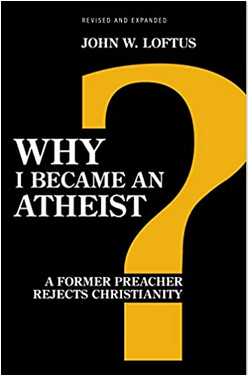
Why I Became an Atheist: A Former Preacher Rejects Christianity


I'm done writing and editing books, so I'm highlighting each one of them in thirteen separate posts.

My first published book, Why I Became an Atheist: A Former Preacher Rejects Christianity, is my magnum opus! If you don't have it you're missing out on what I consider to be my most important work. Pictured is the 2nd edition published in 2012. The 1st edition was published in 2008. Very rare is an atheist book that gets a second edition!

I'm described as a "Former Preacher" in the title. I'm not just a preacher though. I'm a philosopher with several advanced degrees and plenty of classroom time as an instructor of philosophy, ethics, critical thinking, western literature, apologetics, hermeneutics, and a few Bible classes. I taught for the Trine University, Kellogg Community College, Lincoln Christian College, and Great Lakes Christian College. So the words "Former Preacher" don't fully describe me, even though I was in the ministry for about 15 years, mostly while I was also teaching. I had wanted my publisher to call me a "Former Apologist" but they thought few people understood what that means.

I started teaching philosophy and ethics classes in 1985, first for the College of Lake County, in Grayslake, Illinois. In my first class I lost about half my students. As I think back, it was probably due, in part, because I was a flaming evangelical. A larger factor was because the students could not understand me. Yep, that's right. Being in a Ph.D. program at Marquette University, after earning three masters degrees, I didn't know how to bring the information down to college students. So I thought my teaching career was over before it began. Luckily the chair of the philosophy department told me this happens more often than not for first time philosophy instructors. *Whew*

Over time I became an expert teacher, bringing highly complex ideas down to first year students. I eventually learned how to communicate to the average educated person in the pew. My goal was, and is now, to keep it as simple as possible without being simplistic. The problem with this goal is that there are some elitist readers who think I'm ignorant, for if I was smarter and better educated it would reflect in my vocabulary. Smart, highly educated people, it's assumed, use the nomenclature requisite with their educational achievements.

You can see this same "dumbing down", as the elitists call it, reflected in my writings. While I could use technical philosophical language, and quote from the original Hebrew and Greek languages in the Bible, I found that so long as I was accurate I didn’t need to impress people by writing for the scholars.

This is reflected in a few blurbs for my books.