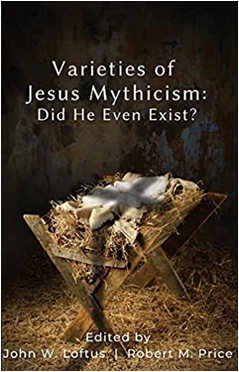
Here is the Amazon link to get this "sure to be a classic" book, right here!
You should read the text of my talk at the Global Center for Religious Research eConference on Jesus Mythicism, which includes my Preface at the end of it.
Trying to get them to read, study, ponder the Bible
One of the old hymns I recall from my Methodist upbringing is Leaning on the Everlasting Arms, which includes these words: “What a blessedness, what a peace is mine, leaning on the everlasting arms. Leaning, leaning, safe and secure from all alarms…” Safe and secure. This security inside the Christian shelter can happen when doubts are denied, when troublesome thoughts are dismissed: “Our priests and preachers must have it right. We believed them when we were toddlers, so why be suspicious now? We’ll keep the faith.” Take it on faith.
“The violent ideology of Christian nationalism”
If you’re as old as I am—born in 1942—you may remember Dinah Shore singing the famous car commercial on television in the 1950s. The song includes these lyrics:
“See the USA in your Chevrolet, America is asking you to call, drive your Chevrolet through the USA, America’s the greatest land of all…”
We had no doubt that America was the greatest land, a sentiment that fueled our patriotism at the time. But we didn’t really think about it. As kids we also played “cowboys and Indians”—however, it never dawned on us that it was through massive genocide of native Americans that European descendants took possession of what is now the USA. Nor did we give much thought to the role that slavery played in the unfolding of American history. Slavery impacted how the US constitution was written; it provoked a bloody civil war, and left an ugly legacy of racism, which still poisons our society.
The fruitless search for extraordinary evidence
A few years ago, a Christian friend told me, after attending Easter morning service, that he had been so moved by the scriptural reading, I Corinthians 15, in which the apostle Paul claims that Jesus
“…was raised on the third day in accordance with the scriptures and that he appeared to Cephas, then to the twelve. Then he appeared to more than five hundred brothers and sisters at one time, most of whom are still alive, though some have died.” (vv. 4-6)
How to Change the Minds of Believers by John W. Loftus
After spending nearly two decades trying to change the minds of Christian believers (my focus in what follows) I still don’t fully know how to do it. Regardless, I’ll share ten helpful tips for readers who, like me, want to bang your heads against a wall. I think it’s worth doing despite the low odds of success. For any success helps rid the world of the harms of religion. Besides, one of the greatest challenges is to change minds, and I like challenges. Plus, I’ve learned a great deal by attempting this important underappreciated task.
On this trip to the Cologne Cathedral I time-traveled back to the latter Middle Ages and into the late Medieval mind to imagine what it must have been like to experience the awe-inspiring magnificence of such a culturally-dominant edifice that literally and figuratively puts all other structures in the shade. Imagine walking into this sanctuary after a long and exhaustive journey from one’s provincial countryside and spartan abode....
To fully feel that world let’s go back to a time when civilization was lit only by fire, centuries ago when populations were sparse and 80 percent of everyone lived in the countryside and were engaged in food production, largely for themselves. Cottage industries were the only ones around in this pre-industrial and highly-stratified society, in which one-third to one-half of everyone lived at subsistence level and were chronically under-employed, underpaid, and undernourished. Food supplies were unpredictable and plagues decimated weakened populations. Read further here.
And provide the evidence for your answer
Carl Sagan was in high demand as a public speaker, and during the Q&A periods, he reports that a common question was, “Do you believe in God?” His response was to ask a question:
“Because the word God means many things to many people, I frequently reply by asking what the questioner means by ‘God.’ To my surprise, this response is often considered puzzling or unexpected: ‘Oh you know, God. Everyone knows who God is.’ Or ‘Well, kind of a force that is stronger than we are and exists everywhere in the universe.’ There are a number of such forces. One of them is called gravity, but it is not often identified with God. And not everyone does know what is meant by ‘God.’ The concept covers a wide range of ideas.” (pp. 181-182, Broca’s Brain: Reflections on the Romance of Science)
Oh you know, God. We live in a god-saturated culture. God in whom we can trust is on our money; the god whom we are under is in our pledge of allegiance; the Bible—god’s word—is in millions of hotel rooms. There are hundreds of thousands of churches built to the glory of god throughout the country. It’s hardly any wonder that people can say, Oh you know, God.
What might have caused that to happen?
Here’s a sensational headline that would shock the world: Pope Resigns, Issuing a Statement that He No Longer Believes in God. But we’ll never see such a headline because, even if a pope stepped down because of nonbelief, the Vatican hierarchy wouldn’t allow such honesty. Other more palatable reasons would be given. I once asked a prominent Italian television journalist if it could possibly be true that the Vatican clergy really believed the theology-on-steroids that the church promotes, e.g. such wackiness as transubstantiation, the immaculate conception, Mary’s bodily assumption into heaven. He responded, “Oh, maybe half of them do. But don’t forget, it’s a business.”
The apostle Paul and John Calvin did their fair share of damage
Christians who are sure that the New Testament reveals a loving god aren’t paying close attention. One of the charter documents of the Christian faith is Paul’s Letter to the Romans. In the opening chapter we find a list of people who deserve to die, because they don’t acknowledge God. The list includes gossips and rebellious children, “…since they did not see fit to acknowledge God, God gave them up to a base mind and to improper conduct.” (Romans 1:28). “For the wrath of God is revealed from heaven against all ungodliness and wickedness…” (Romans 1:18) And there’s more: “...by your hard and impenitent heart you are storing up wrath for yourself on the day of wrath when God’s righteous judgment will be revealed.” (Romans 2:5) “…for those who are factious and do not obey the truth, but obey wickedness, there will be wrath and fury.” (Romans 2:8)
All of our god(s) were invented in utter, total isolation
If the Bible is what the devout claim it is, we should be able to trust the information it provides about god, right? Alas, so often—far too often—that’s hard to do. How do modern Christians feel about these two verses, Exodus 29:17-18, i.e., proper worship procedure regarding animal sacrifice:
“Then you shall cut the ram into its parts and wash its entrails and its legs and put them with its parts and its head and turn the rest of the ram into smoke on the altar. It is a burnt offering to the LORD; it is a pleasing odor, an offering by fire to the LORD.”
I’m assuming not too many Christians would welcome this kind of smokey ritual on Sunday mornings. The author of this text believed that (1) his god was close enough overhead to smell the smoke from the fire; (2) his god had a sense of smell; (3) his god savored the aroma of burning animal flesh. Of course, this is a sampling of primitive, superstitious religion: one way to get right with a god was animal sacrifice. Another aspect of primitive religion is disguised here by the English translation. The word LORD in all caps is the rendering of the divine name; this god’s name was Yahweh—as reconstructed from four Hebrew consonants (add different vowels and you get Jehovah). Calling on the name of the god is a kind of magic, which survives to this day when Christians say, “…in Jesus’ name we pray.”
[First published on 10/5/20] Because this is the haunted month of Halloween
here's something to spook ya all!
I'm always interested in new angles to argue my case against Christianity. Kris Keys does that in the excellently researched essay below. He argues there is more evidence for the resurrection of Vampires and Revenants than there is for the resurrection of Jesus.
Introductory comments by Kris Keys:
Well this is my first time writing a blog post and little did I know it would be for the website Debunking Christianity!! I find this to be completely hilarious as I am not in of myself militantly opposed to Christianity in of itself; I tend to dislike Evangelicals but that is because I view them as hypocritical and blatantly power hungry but of course this description would not apply to all Christians. As probably the readers of this post have deduced by now I am not a Christian, but I am also not an atheist either. I tend to be rather eclectic in my views. I fancy myself to be broad minded and open to change.
I am a schoolteacher by profession, and I have taught both social studies and science at the high school level. I have dual degrees in both fields. In my not remotely enough spare time I enjoy reading folklore, Medieval history, sociology, anthropology and other subjects. Basically a lot of stuff. Over the years I have heard the Christian argument for the physical resurrection of Jesus and at one time I found this argument to be convincing, but more and more for many varied reasons I became rather skeptical of it.
None of this explains though, how this essay came about! Nothing remarkable about it really. I was scrolling through Facebook and I saw John Loftus’s profile. In discussion with him I mentioned that one could use the resurrection argument to demonstrate the existence of vampires and I showed him a response I wrote to a friend of mine on this. John asked me to do a write up for him.
So here is a write up I never seriously figured I would write up on a blog, one that I never suspected I would write for. So I hope everyone enjoys it. So without further ado, here is my attempt to show that the Christian argument for the resurrection of Jesus would also demonstrate vampires exist. I will leave it up to you dear readers to determine if Jesus rose from the dead and if you need to invest in crucifixes and garlics now; or that perhaps claims of the dead returning bodily just should not be given the benefit of the doubt. You decide.
Let me explain why originalism is a misleading misinformed bogeyman of conservatives.
What the church doesn’t want them to think about
Worship services are a form of show business, at which some Christian brands excel especially. How much does the Vatican spend every year on its worship costumes alone? But most denominations, while not so extravagant, do their best to “put on the show,” which includes music, liturgy, ritual, props, sets—those stained-glass depictions of Bible stories—and the trained actors, i.e., the clergy. All this is designed to promote the beliefs and doctrines of each denomination. But there are so many different denominations: who is getting Christianity right? Is there any denomination that urges its followers to look beyond the liturgies? What’s behind it all? What are the origins of the beliefs celebrated in liturgies?