Showing posts sorted by date for query ridicule. Sort by relevance Show all posts

July 19, 2026

On Resurrecting David Hume From the Dead!

I chose this title due to the double entendre. Hume, of course, might roll over in his grave if he saw it expressed in terms of a miracle. ;-) Here's what I wrote in my book, describing the uphill problem I have in defending David Hume on miracles in The Case against Miracles, p. 552].
Since Christians are convinced Hume’s arguments against miracles have been “refuted” (per William Lane Craig in a personal conversation), some atheists are trying to reach out to Christians by avoiding Hume entirely. Benjamin Blake Speed Watkins, who Hosts and Produces Real Atheology – A Philosophy of Religion Podcast, is one of them. He said, “I see arguments against miracles as separate from Hume. We can have substantive discussion without ever appealing to him.” Now this can be done, I don’t doubt. But I don’t see the need to do it. I also think we should give credit where credit is due. I can’t imagine ignoring David Hume, the philosopher who originally put the issue of miracles up for discussion, like no other had done before. That would be an injustice. I understand that Christians identify the best arguments against miracles with Hume’s arguments. I also understand they think Hume’s arguments fail. So I’m not oblivious they conclude that with Hume’s demise so also goes the case against miracles. Just the same, it makes sense to defend Hume if he can be defended, and I think he can. When we do so successfully it doubly undercuts Christian apologetics. For not only do we show Hume’s arguments defeat the believability of miracles. By showing Christians are wrong about Hume, it also shows how badly they argue their case on behalf of miracles.
Richard Carrier recently said I'm wrong to try, via email:
I think Hume should be dealt with much more briefly as having said something useful but centuries obsolete and thus no longer worth distracting ourselves with. That just helps theists, because they can throw up sand and argue endlessly over his choice of sentences and wording, when we could just say “why are you still talking about that, that’s centuries obsolete?” and thus pull the rug out from under that entire tactic. Force them instead to deal directly with the modern math. They will have a far harder time coming up with convoluted rhetoric to evade simple math than to make hay out of some long dead provocateur's 18th century prose.
Then again:
I don’t see value in trying to fix or explain hundreds years old obsolete stuff, even when clever or historically important. That wastes a lot of energy to no point. It’s great if you are doing history of the 18th century or something. But in philosophy, the name “Hume” should have no value argumentatively. So I think it’s pointless to try and fix “him.” Forget him. We have the benefit of two hundred plus years of scientific, logical, and mathematical advances since. We should just formulate the correct argument and be done with it. His name never need be mentioned; and mentioning it is just a distraction that triggers the howling monkeys of Christian apologetics. Make them confront the correct argument, rather than waste time arguing over what Hume’s centuries-old selection of words meant. Which fits into my ideal principle: never give a Christian an opening to derail a conversation by arguing over irrelevant trivia instead of the actual point being made. Try to prevent rather than facilitate that. It’s hard. But it should be the best aim.
From the outset, just to be sure, I have argued against miracles without depending on Hume. I mentioned him twice in two papers with just one link each. I did so for The Secular Web. One is titled, Hail Mary: Was Virgin Mary Truly the Mother of God’s Son?, and another one is titled, Assessing McIntosh’s Sophisticated Defense of Miracles.

July 17, 2026

David Hume “Of Miracles” and Religions (#97-100) with Notes by John W. Loftus

David Hume: “A miracle may be accurately defined as a transgression of a law of nature by a particular volition of the Deity, or by the interposition of some invisible agent.
--------
Hume’s target was the Christian religion with its miracles. He argued against the probability of human testimony on behalf of miracles focusing on the Christian religion with its miracle claims. The root word “relig” with its endings (-ion –ions -ious –ionist) occurs twenty times in this chapter].

Below are a few paragraphs from the end of Hume's chapter (#97-100) with notes.

October 17, 2025

The Best Cure for Christianity Is Reading the Bible, Essay No. 6

Bad theology in the Old Testament


Not too long ago I saw a video: a conservative woman being interviewed by a man who wanted to know her opinion about what should be taught in public schools. She was adamant that the Bible should be included in the curriculum, but that books that advocated immoral or radical ideas must be banned. The man mentioned that he knew of a book that described a sordid family story: a man had two daughters who got him drunk on two successive nights, took turns having sex with him—and got pregnant. The woman didn’t hesitate: of course that book should be banned. The fellow then pointed out that this story is in the Bible, Genesis 19:30-38, about Lot and his daughters. The woman was shocked…that the interviewer could tell such a lie.

August 08, 2025

The Best Cure for Christianity Is Reading the Bible, Essay No. 3

Matthew 6: Yet more deeply flawed Jesus-script 
 

In my article here last week, I mentioned that the Sermon on the Mount is treasured by Christians as the pinnacle of wisdom—Jesus at his best. Yet, if we asked churchgoers where we can find this famous sermon, or how recently they’d read it—read it carefully, critically—what would their answers be? Surveys have shown that Bible reading is not a favorite hobby among those who profess to be Christian. And no wonder: there are texts, especially in the Sermon on the Mount, that would prompt many of the devout to say, at least to themselves: “This doesn’t make sense.” My article last week was about Matthew 5, so now we move on to Matthew 6 (this famous sermon is found in chapters 5-7).

July 04, 2025

Why Do Christians Keep on Being Christian?

There is so much wrong with their version of reality


Of course, there’s something seductive, irresistible, about believing you’re on splendid terms with the creator of the Cosmos. How great it is to be able to communicate—through meditation and prayer—with the force that guides the affairs of the world. But it’s an uphill battle to maintain that this is not delusional. It’s the gimmick that clergy of so many different religions have convinced their followers to embrace. Christianity is especially guilty.

January 03, 2025

We Survived Yet Another Season of Christmas Irrelevance

Addressing irrelevance with reality and ridicule


We know nothing—absolutely nothing—about how and when Jesus was born. The birth narratives in Mathew and Luke have been studied and analyzed ad nauseam by scholars, and there is not a single scrap of history in either of them. With just a little bit of careful study, churchgoers could discover this truth—but they would have to ignore the pleading of clergy and apologists to take the stories at face value. Yet thousands of churches still put on Christmas pageants featuring Mary and Joseph arriving in Bethlehem, the baby Jesus dozing in a manger, surrounded by adoring shepherds and Wise Men. The Wise Men are a most unwelcome addition to the Jesus tradition. It is really not smart to add astrology to the mix of Christian theology, already spoiled by ancient superstitions and magical thinking. We read that astrologers from the East had seen Jesus’ star in the sky—and set off to worship him. This is a boast of the Jesus cult! It was a common belief in the ancient world that the births or accomplishments of important people were accompanied by special signs in the heavens.

December 27, 2024

Religions Thrive on Naïve Ignorance

But also on arrogant and aggressive ignorance


A few months ago, an elderly Catholic women admitted to me that their priests told them not to think about what they learned as children in catechism. But I suspect this is a common approach of clergy everywhere: “Just believe that we know what we’re talking about—after all, we learned all there is to know about god in seminary—and our intense prayers keep us in touch with him.” Especially when eternal life is at stake, why take chances? “Of course, our church, our denomination, has it right.”

June 14, 2024

Christianity Thrives Because of the Failure of Curiosity

It doesn’t take much curiosity to puncture theology


How does the church get away with its theology games? A church in Texas recently refused entrance to a blind woman and her service dog, as reported in an article published a few days ago by The Friendly Atheist, Hemant Mehta. Falling far short of the compassion of Jesus, church security was worried about the dog, because the worship service included “a live band and flashing lights.” Why are we not surprised? These are tricks of the trade. The clergy have learned how to be dramatists. For a very long time, worship has been entertainment: putting on a show, using razzle-dazzle to give theology as much heft as possible: ceremony, music, costumes, rituals, art, scenery and set design. And it works. Folks go to the churches where they find familiar, cherished reinforcements of their certainties about god and securing eternal life. Just savor the moment and the emotion. The clergy might as well say—as part of this heavenly bargain: “Please don’t think too much about what we’re doing, that might deflate the high you’re feeling.”

March 03, 2024

Of Miracles: In Defense of David Hume against Graham Oppy

 David Hume (1711-1776) offered some good philosophical arguments against miracles that still resonate today. His arguments focused on the unreliability of human testimony on behalf of miracles. He did not live in a technological age like ours with modern forensics that include blood analysis, with tests that can determine one’s type, and detects diseases, poison, drugs and alcohol. We also have x-ray technology, DNA evidence, CAT scans, dash cams, and security cameras at convenience stores, on street intersections, and neighborhood homes. Especially noteworthy are the ubiquitous number of cell phones that give us immediate access to the police by a 911 call, cameras that can capture any event on video, and GPS tracking capability showing where we are at any given time. So Hume didn’t have the capability we do to establish miracles, or debunk them.

In our day the James Randi Educational Foundation (JREF) offered a one-million-dollar prize “to anyone who can show, under proper observing conditions, evidence of any paranormal, supernatural, or occult power or event.” From 1964, when it first offered such a challenge, until 2015 when they stopped doing it, no challenger had even gotten past the preliminary test.[1] That should settle the question of miracles. If not, why not?

One might ask why we even need philosophical arguments. Why not just teach how science works and why the methods of science are the best we have to get at the truth? In a real sense we don’t need philosophical arguments, per se, including those from Hume.[2] However, given so many possible existential threats to life on our planet, we should do everything we can to reach people who value blind faith over scientific evidence.[3] So practically speaking, some believers might be attentive to listen to Hume, rather than to Darwin, Sagan, Shermer, Dawkins and others.[4]

One of the best philosophical arguments that can help believers acknowledge the value of sufficient evidence, objective evidence, scientific evidence, is found in my book, the Outsider Test for Faith. [5] It challenges them to doubt their own culturally indoctrinated childhood faith for perhaps the first time, just as if they never heard of it before. It calls on them to require of their own religious faith what they already require of the religious faith’s they reject. It forces them to rigorously demand logical consistency with their doctrines along with sufficient evidence for their faith, just as they already demand of the religions they reject.

December 17, 2023

O Holy Night! How Matthew Screwed Up the Christmas Story

[First Published 12/21/18].          

Get those Wise Men out of the stable…  

We can imagine the literary agents for Matthew, Mark, Luke, and John meeting for drinks one Friday evening after work. They all get texts that the church’s Authorized Bible Committee has decided to publish the four gospels together, back-to-back. They all wince. Not a good idea! This will encourage the faithful to compare the four Jesus accounts. Matthew and Luke plagiarized (and altered) Mark extensively—without telling anyone—and the author of John’s gospel was pretty sure that the other three hadn’t told the story well at all, and made up stuff to ‘improve’ to tale. What a mess.

November 17, 2023

Christianity’s Embarrassing Apostle Paul Problem

Hallucinations are not a credible foundation for any religion


The church gets away with a far, far too much because most of the laity don’t bother to read the Bible, let alone study it carefully. This failure enables the clergy to nurture an idealized version of the faith—indeed, an idealized version of Jesus—unhindered by so much of the nasty stuff in full view in the gospels and in the letters of the apostle Paul. The clergy are quite content that the folks in the pews don’t go digging about in these documents. Instead, ritual, sacred music, costuming, stained glass windows—church décor in general—allow the laity to savor a false version of the faith promoted by the ecclesiastical bureaucracy.

October 30, 2023

On Vampires and Revenants Resurrecting from the Dead, Written by Kris Keys

[First published on 10/5/20] Because this is the haunted month of Halloween here's something to spook ya all!

I'm always interested in new angles to argue my case against Christianity. Kris Keys does that in the excellently researched essay below. He argues there is more evidence for the resurrection of Vampires and Revenants than there is for the resurrection of Jesus.

Introductory comments by Kris Keys:

Well this is my first time writing a blog post and little did I know it would be for the website Debunking Christianity!! I find this to be completely hilarious as I am not in of myself militantly opposed to Christianity in of itself; I tend to dislike Evangelicals but that is because I view them as hypocritical and blatantly power hungry but of course this description would not apply to all Christians. As probably the readers of this post have deduced by now I am not a Christian, but I am also not an atheist either. I tend to be rather eclectic in my views. I fancy myself to be broad minded and open to change.

I am a schoolteacher by profession, and I have taught both social studies and science at the high school level. I have dual degrees in both fields. In my not remotely enough spare time I enjoy reading folklore, Medieval history, sociology, anthropology and other subjects. Basically a lot of stuff.  Over the years I have heard the Christian argument for the physical resurrection of Jesus and at one time I found this argument to be convincing, but more and more for many varied reasons I became rather skeptical of it. 

None of this explains though, how this essay came about! Nothing remarkable about it really. I was scrolling through Facebook and I saw John Loftus’s profile. In discussion with him I mentioned that one could use the resurrection argument to demonstrate the existence of vampires and I showed him a response I wrote to a friend of mine on this.  John asked me to do a write up for him.

So here is a write up I never seriously figured I would write up on a blog, one that I never suspected I would write for. So I hope everyone enjoys it. So without further ado, here is my attempt to show that the Christian argument for the resurrection of Jesus would also demonstrate vampires exist. I will leave it up to you dear readers to determine if Jesus rose from the dead and if you need to invest in crucifixes and garlics now; or that perhaps claims of the dead returning bodily just should not be given the benefit of the doubt. You decide.

September 15, 2023

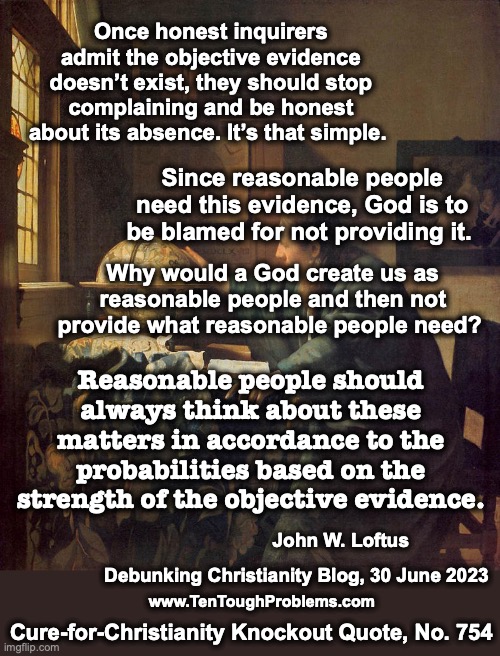
Theologians Squirm and Fret When We Ask for EVIDENCE

Why does their god play hide and seek?

We can assume that some (many?) churchgoers read the gospels, but, it would appear, without critical thinking skills fully engaged. When the devout come across Mark 14:62, does it bother them that Jesus was wrong? At his trial, Jesus was asked point blank if he was the messiah, to which he replied: “I am, and you will see the Son of Man seated at the right hand of the Power and coming with the clouds of heaven.” The main thrust of Mark’s gospel was that kingdom of his god was so close. But obviously those at his trial did not witness the arrival of Jesus on the clouds. The apostle Paul was confident too that Jesus would arrive in the sky soon. He promised members of the Thessalonian congregation that their dead relatives would rise to meet Jesus—and that he too would be there to join them (I Thessalonians 1:15-17). So Paul was wrong as well.

July 07, 2023

Asking for EVIDENCE for God: Why Is that So Hard to Grasp?

Sentiments about Jesus do not qualify


According to the devout, evidence for their god is so obvious, “I feel Jesus in my heart!” “Just open the Bible, it’s right there.” “People all over the world have seen visions of the Virgin Mary.” “Every day I receive guidance from my god in prayer.” “The holy spirit fills me with joy during Sunday worship.” 


Please note these claims are usually made by people who have been groomed from a very young age to accept what they’re been told by preachers and priests. Or maybe they converted to Christianity as adults—which is no surprise, since the marketing of Jesus is a multi-billion-dollar business. There are thousands of churches ready to welcome converts into their grooming communities.

June 30, 2023

The Morale of Christian Clergy Is Taking a Big Hit

No surprise, given the mess their religion is in


1.     Christians can’t agree on who is right, what god wants


When Christians are off to church on a Sunday morning, they might have to drive past a few churches of other denominations. Apparently it never crosses their minds to stop at one of these—after all, “We’re all Christians, aren’t we?” But that’s exactly the problem: Christians have never been able to agree on what Christianity is. They’ve been fighting about this for centuries; the Catholic/Protestant divide is especially pronounced. We can be sure Catholics won’t stop at Protestant churches, and Protestants—with contempt and ridicule for the Vatican—wouldn’t think of stopping at a Catholic church.

March 26, 2023

"I SEEK TO PROVE -- FREE WILL IS IMPOSSIBLE AND IMMORAL"

I have known the author of the piece below for many years. Both he and I are most interested in what you think of its strongest and weakest parts, so please comment. The content in this essay deserves the utmost serious consideration.

 --John W. Loftus.  

 SOMETHING NEW AND DECISIVE ABOUT FREE WILL

LETHAL TO THE NEED FOR SAVIOR JESUS

WHY ARE YOU WHO YOU ARE?

COMPARE THE EFFECTS -- ONLY YOU KNOW – OF THE FACTORS MAKING YOU

AND IMPOSED NOT CHOSEN – CAN ANYONE HAVE FREE WILL?

By Stanley W. Ayre -- March 2023

December 17, 2022

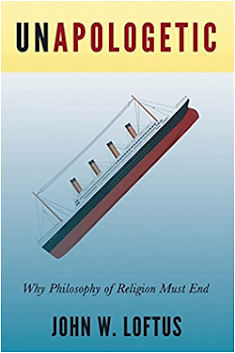
Unapologetic: Why Philosophy of Religion Must End


I'm done writing and editing books, so I'm highlighting each one of them in thirteen separate posts.

Today let's consider my 2016 book, Unapologetic: Why Philosophy of Religion Must End. Just like my books The Outsider Test for Faith, and How To Defend the Christian Faith, this one was also forged in the heat of debate here at DC. I don't expect Christian philosophers to agree with it until after they abandon their faith. Secular philosophers have disagreed with it. But noteworthy ones agree. Actually, I think most all scientifically minded atheist philosophers should agree.

December 16, 2022

Harry Potter Changed Water Into Wine—No, Wait—

Miracles or magic: What’s the difference?


One crucial, fundamental rule for responsible Bible study—pursued by adults who can set aside “what the church says”—is this: be curious, be very curious. Another fundamental rule follows as well: be skeptical, be very skeptical. This requires looking below the surface, which should include exploring the writings of biblical scholars: every chapter and verse of the Bible has been studied closely, and the results published.

December 01, 2022

How to Change the Minds of Believers, by John W. Loftus


How to Change the Minds of Believers by John W. Loftus


After spending nearly two decades trying to change the minds of Christian believers (my focus in what follows) I still don’t fully know how to do it. Regardless, I’ll share ten helpful tips for readers who, like me, want to bang your heads against a wall. I think it’s worth doing despite the low odds of success. For any success helps rid the world of the harms of religion. Besides, one of the greatest challenges is to change minds, and I like challenges. Plus, I’ve learned a great deal by attempting this important underappreciated task.

October 28, 2022

On Vampires and Revenants Resurrecting from the Dead

[First published on 10/5/20] Because this is the haunted month of Halloween here's something to spook ya all!

I'm always interested in new angles to argue my case against Christianity. Kris Keys does that in the excellently researched essay below. He argues there is more evidence for the resurrection of Vampires and Revenants than there is for the resurrection of Jesus.

Introductory comments by Kris Keys:

Well this is my first time writing a blog post and little did I know it would be for the website Debunking Christianity!! I find this to be completely hilarious as I am not in of myself militantly opposed to Christianity in of itself; I tend to dislike Evangelicals but that is because I view them as hypocritical and blatantly power hungry but of course this description would not apply to all Christians. As probably the readers of this post have deduced by now I am not a Christian, but I am also not an atheist either. I tend to be rather eclectic in my views. I fancy myself to be broad minded and open to change.

I am a schoolteacher by profession, and I have taught both social studies and science at the high school level. I have dual degrees in both fields. In my not remotely enough spare time I enjoy reading folklore, Medieval history, sociology, anthropology and other subjects. Basically a lot of stuff.  Over the years I have heard the Christian argument for the physical resurrection of Jesus and at one time I found this argument to be convincing, but more and more for many varied reasons I became rather skeptical of it. 

None of this explains though, how this essay came about! Nothing remarkable about it really. I was scrolling through Facebook and I saw John Loftus’s profile. In discussion with him I mentioned that one could use the resurrection argument to demonstrate the existence of vampires and I showed him a response I wrote to a friend of mine on this.  John asked me to do a write up for him.

So here is a write up I never seriously figured I would write up on a blog, one that I never suspected I would write for. So I hope everyone enjoys it. So without further ado, here is my attempt to show that the Christian argument for the resurrection of Jesus would also demonstrate vampires exist. I will leave it up to you dear readers to determine if Jesus rose from the dead and if you need to invest in crucifixes and garlics now; or that perhaps claims of the dead returning bodily just should not be given the benefit of the doubt. You decide.