Showing posts with label Case against Miracles. Show all posts

April 22, 2024

David Hume's Argument against Miracles Cannot Be Disputed. I Prove It Beyond Any Reasonable Doubt!

The title to this post echoes the certainty of David Hume, known as the greatest English speaking philosopher. He said:
I flatter myself, that I have discovered an argument which, if just, will, with the wise and learned, be an everlasting check to all kinds of superstitious delusion, and consequently, will be useful as long as the world endures. [Enquiry "Of Miracles" X (#86)]
I argue this is still true. Now I'm not sure why many Christian intellectuals ignore my books and my arguments. Many or most evangelical apologists know of them. So I'll say it. I think many of them have decided not to deal with them, or to give them any oxygen, because they cannot dispute them. It's so much easier to go after popular but low hanging fruit. Apologist Frank Turek, for instance, knows of my work but never addresses it in his daily posts at X (or Twitter). I find that very odd. So I must conclude he cannot dispute them.

Okay this sounds like I'm challenging apologists to a Gunfight at the O.K. Corral, so it makes me arrogant. But I have the goods. Others do as well. Is it really arrogant to say Christianity of the evangelical kind is bunk, when it is in fact bunk? No it's not, not anymore than it is to say Leprechauns don't exist. Many atheists, agnostics, deists, and even liberals agree with me on that score. But because I state the obvious many evangelical apologists will conclude I'm uniformed of the underpinnings of their faith, since they are so sure of it. They might also think this of the title to this blog. I can't change that now. But if they read just one of my papers they will see my scholarship. Check out just one peer reviewed paper, in defense of David Hume on miracles at The Secular Web. THIS ONE. Can you dispute it? I say you can't do it. Timothy McGrew, I’m looking at you.

August 08, 2022

"HUME ON PROOF AND MATHEMATICAL PROBABILITY" by John W. Loftus

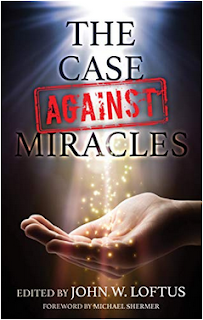
What follows is the Appendix to my anthology The Case against Miracles (pp. 551-560). I consider several parts of that book to be a major defense of David Hume. I know there is some debate on Hume, but what Hume said on miracles withstands the criticisms leveled at him. They come from both Christian apologists and philosophers (as one would expect), but also from some atheist philosophers, like Michael Martin (Atheism: A Philosophical Justification, pp. 194-196), Michael Levine (The Cambridge Companion to Miracles, pp. 291-308), and Graham Oppy (Arguing About Gods, pp. 376-382), who strangely says "Hume's argument against belief in miracle reports fails no less surely than do the various arguments from miracle reports to the existence of an orthodoxy conceived monotheistic god" (p. 381). Agnostic/atheist John Earman thinks Hume's argument is an Abject Failure (as seen in his book by that title). And while J.L. Mackie defends Hume against some objections, even he thinks Hume's argument needs "improvement" (p. 25) by being "tidied up and restated" (p. 17) due to "inaccuracies" (p. 27), with one part he calls "very unsatisfactory" (p. 23).

Here's a brief introduction to the debate on miracles LINK. Now for my Appendix:

April 30, 2022

“The Rationalization Hypothesis: Is a Vision of Jesus Necessary for the Rise of the Resurrection Belief?” — by Kris Komarnitsky

I had previously highly recommended an essay by Kris Komarnitsky in my chapter on the resurrection for The Case against Miracles.

When it came to my chapter 18 on the resurrection of Jesus I mentioned the theories that help explain the origins of the belief in Jesus' resurrection. I stressed one theory above all the rest:
One theory has recently been defended by Kris Komarnitsky, author of "Doubting Jesus’ Resurrection: What Happened in the Black Box ?" He has done an excellent job of showing what could have happened in an online post on Mathew Ferguson’s blog titled, "The Rationalization Hypothesis: Is a Vision of Jesus Necessary for the Rise of the Resurrection Belief?" I find it to be the most detailed defense of this theory, making it worth considering, complete with four real-life examples of it in history. He takes issue with the bereavement visionary hypothesis of the disciples, widely regarded as a plausible naturalistic explanation for the data, and argues instead for what he calls the cognitive-dissonance-induced ration- alization hypothesis. The question he discusses is whether bereavement visions produced the belief that Jesus arose from the dead, or whether the resurrection belief came first due to cognitive dissonance reducing rationalizations, favoring the later. Go read it. Now! Forget the swoon theory that Jesus didn’t actually die, the conspiracy theory that the disciples purportedly concocted to perpetrate a hoax, the impersonation theory that someone impersonated Jesus, or the unknown tomb theory where the disciples went to the wrong tomb.
Then I linked to it. It has now been released again, for which I thank Matthew Ferguson! “The Rationalization Hypothesis: Is a Vision of Jesus Necessary for the Rise of the Resurrection Belief?” — by Kris Komarnitsky.

December 22, 2021

Introducing my book, The Case against Miracles


After a two year break from producing another anthology. I finally decided to do one again. My decision came from debates on Facebook, plus the prodding of Richard Miller (who now posts here at DC). Dr. Miller and I were going to co-edit the book together but it just didn't work out. I thank him for prodding me to do it, and I think the book might have been better if it had worked out.

September 09, 2021

Phil Bair On Extraordinary Evidence For Miracles

Phil Bair was suggested by James K. Walker to debate me. Walker is a Christian apologist and former Mormon who is President at Watchman Fellowship. I hadn't heard of Phil before. But he seems smart enough. Anyone who has read my anthology on miracles and still disagrees gets my attention. 

Phil offered two objections to my defense of the aphorism, "Extraordinary claims require extraordinary evidence." 

ONE) Phil Bair: “You have no criteria for identifying what qualifies as extraordinary evidence for an extraordinary claim.” My response:

July 28, 2021

On Promoting "The Case against Miracles"

As of this writing all of the typos have finally been fixed in The Case Against Miracles, thanks not to Hypatia Press but to William Kelly, a 42 year old who lives in South Carolina, self-described as a "Vegangelical Atheist who loves science and philosophy." Things might change with the upcoming anthology Varieties of Jesus Mythicism, so we'll see.
Kelly as you might guess, is a fan of my work. I recently thanked him profusely for his efforts and sent him the corrected PDF of the book as a way of saying thanks. [On July 20th I asked Hypatia Press when buyers can expect to get the corrected version, but I still haven't heard back as of today.] 
Kelly wrote back, saying:

June 15, 2021

From Tom Flynn's Review of "The Case against Miracles"

Tom Flynn is the Senior Editor of Free Inquiry magazine. He just published a review of my anthology The Case against Miracles. In it he wrote:
In 2008, John W. Loftus launched what would become a definitive series of anti-apologetic works. The Case against Miracles is the capstone volume of this astonishing output, and it's an impressive achievement. Any thoughtful Christian whose conviction rests on the evidence of miracles who reads this book with an open mind will be hard pressed not to abandon--or at least profoundly rethink--his or her beliefs. Of course, true believers seldom approach works critical of their faiths with an open mind, which is why The Case against Miracles will probably be of greater value to secular students of religion and especially to those drawn to the challenges of anti-apologetics.
He joins others in recommending this anthology that includes an amazing group of accomplished authors, which can be seen here. So let me guess, this is a good book. ;-) If you value what reviewers are saying about it, get it. Read it. Help spread the word!

February 16, 2021

Answering Two Objections Against Miracles

As I'm the editor of a highly acclaimed anthology on miracles, Phil Bair wants to debate me. He has some impressive credentials. So I asked him what his objections were. He offered two of them.
You already know one of my objections: you have no criteria for identifying what qualifies as "extraordinary evidence" for an extraordinary claim. If there is no criteria, that presents three problems. 1. your principle is subjective, 2. you have no basis for telling us our evidence is not extraordinary enough, and 3. we have no way of knowing whether our evidence would satisfy anyone who holds to this principle because they are unwilling to give us any guide for determining this. If you expect us to satisfy the requirement, you have to give us a way of measuring that aspect of the evidence.
In answer this is what I call obfuscationist apologetics. The attempt is to get sidetracked into interesting issues that are beside the point. Rather than clarifying the issue to be addressed the goal is to distract us away from it, or to muddy the waters for the unwary.

First, this is not my problem. This is a problem for Bair's god. His god should know what would be convincing for rational people who cannot believe. The question then becomes why such a god who wants us to believe or be damned, is not providing it. Second, if I were to go further I would say it must be sufficient objective evidence. The reason why this is the case is because there's no objective evidence at all for any of the miracles that form the basis for Bair's Christian faith. Third, as to offering criteria goes I would offer clear-cut obvious concrete examples instead, like the unevidenced belief that a virgin gave birth to the second person of a Trinitarian god in an ancient pre-scientific superstitious age, best described as one of Kooks and Quacks of the Roman Empire. Then I would ask Bair to state his criteria for believing such an extraordinary claim, to see if included, was any objective evidence at all, which isn't. Hence I could simply dismiss his claim, which should be the end of it, per Hitchens' Razor.
The other objection I have is that your rejection for miracles does not rest on the principles endemic in the discipline of historiography. They rely on philosophical presuppositions rather than historiographical principles. That philosophical bias does not establish a basis for rejecting historical claims that don't conform to it. This forces the investigator to accept explanations for historical events even if they are false, and forces him to reject explanations even if they are true. Based on this, my contention is that you are simply defining historical methodologies out of existence in order to defeat them in a way you find convenient but not in a way that honestly addresses the merits of the evidence.
Will someone please tell me why Bair accuses me of that which Bair is guilty of doing? Methinks he doth protest too much. This link of arguments should refute such an unfounded hypocrtical claim. Let me just quote one passage from that previous link, something Dr. Bart Ehrman said in his book, Jesus Interrupted, about the historian and miracles here:
Why was the tomb supposedly empty? I say supposedly because, frankly, I don't know that it was. Our very first reference to Jesus' tomb being empty is in the Gospel of Mark, written forty years later by someone living in a different country who had heard it was empty. How would he know?...Suppose...that Jesus was buried by Joseph of Arimathea...and then a couple of Jesus' followers, not among the twelve, decided that night to move the body somewhere more appropriate...But a couple of Roman legionnaires are passing by, and catch these followers carrying the shrouded corpse through the streets. They suspect foul play and confront the followers, who pull their swords as the disciples did in Gethsemane. The soldiers, expert in swordplay, kill them on the spot. They now have three bodies, and no idea where the first one came from. Not knowing what to do with them, they commandeer a cart and take the corpses out to Gehenna, outside town, and dump them. Within three or four days the bodies have deteriorated beyond recognition. Jesus' original tomb is empty, and no one seems to know why. Is this scenario likely? Not at all. Am I proposing this is what really happened? Absolutely not. Is it more probable that something like this happened than that a miracle happened and Jesus left the tomb to ascend to heaven? Absolutely! From a purely historical point of view, a highly unlikely event is far more probable than a virtually impossible one..." [See pages 171-179]

January 17, 2021

Atheist & Christian Book Club with John Loftus On "The Case Against Miracles

I know this is a long podcast, just over 2 hours. But I think I raise a number of good points, some of which came out in the last half hour or so.

September 06, 2020

Miracle Claims Asserted Without Relevant Objective Evidence Can Be Dismissed!

I recorded a video talk for two virtual conferences this past Labor Day weekend, for the International eConference on Atheism, put on by the Global Center for Religious Research, and for the Dragon Con Skeptic Track. I'm very grateful for these two opportunities. That video will be released sometime soon. In what follows is the text of my talk. Please share if you want others to discuss it with you. Enjoy the discussion!

Today I’m arguing, along the same lines as Christopher Hitchens did, that “What can be asserted without evidence can also be dismissed without evidence.” [God Is Not Great: How Religion Poisons Everything (New York, Twelve. 2007), p.150.] Specifically I’m arguing that “Miracle Claims Asserted Without Relevant Objective Evidence Can Be Dismissed. Period!”

I think all reasonable people would agree. Without any relevant objective evidence miracle claims shouldn’t be entertained, considered, believed, or even debunked. I intend to go further to argue that as far as we can tell, all, or almost all miracle assertions, lack any relevant objective evidence, and as such, can be dismissed out of hand, per Hitchens.

April 27, 2020

An Excerpt From My Introduction to "The Case Against Miracles"

A miracle must be an event caused by a supernatural force or being, a god. Such an event could not take place on its own in the natural world without the action of a god. It must be an event which involves the interfering, or suspension, or transgressing, or breaching, or contravening, or violating of natural law. Such an event could not be explainable by science because it would be an event impossible to occur by natural processes alone. A miracle is therefore an extraordinary event of the highest kind.

April 13, 2020

Perhaps Now Is The Time To Read My New Anthology!

If you're reading more books due to spending more time at home, perhaps now is the time to read my latest anthology, The Case against Miracles. It just may be the crowning work of my publishing career. It should be interesting to watch apologists deal with it. Here are links to the paperback edition, and the Kindle edition. Some recommendations of it are below:

February 18, 2020

Gary Habermas Recommends My Anthology On Miracles!

This is pretty significant as Gary Habermas is probably the reigning evangelical apologist focusing on the resurrection, next to William Lane Craig and Mike Licona. If there is anyone who still fails to appreciate this anthology maybe Habermas might change their minds:
Christians need be aware of what non-Christian scholars are saying. In this thoughtful and stimulating volume, editor John Loftus brings together a number of the most accomplished atheists and other skeptics to deal with the crucial topic of miracles, an issue that is important on all sides. --Gary R. Habermas, Distinguished Research Scholar & Chair, Dept. of Philosophy, Liberty University.
Gary tells me he's recommending this book to his students. My hat goes off to all the authors that helped make it such an excellent book!

February 07, 2020

Are Miracles Proof of God? Don’t. Go. There.

Yet more theological incoherence

The religious bureaucrats who hovered around Jesus—and conspired against him—suspected that he performed miracles because he had help from demonic powers (Matthew 12:24): “It is only by Beelzebul, the prince of demons, that this fellow drives out demons.” Supposedly they knew a thing or two about the hierarchy in the spiritual realm, and they assumed that anyone who could kick out demons had been deputized by Satan. Of course, Jesus didn’t see it that way at all, and got the better of demons whenever he had the chance. He ordered them about, as we find in the dramatic story in Mark 5: he transferred the demons into a herd of swine.

January 09, 2020

How Does One Avoid Bias? What If it's Impossible to Corroborate the Resurrection?

From time to time I'll add some discussion about my anthology The Case against Miracles. Click on the Tag Case against Miracles below for more entries.

This comes from a discussion on Bart Ehrman's blog, which I've been made a temporary moderator.

Question:
How does one deal with and avoid a specific bias towards secularism in one’s intellectual work? I ask because there is no doubt such a bias exists, and there is no doubt that it debilitates rational thought just as readily as any other bias. The question is this: how do those of us who experience such a bias make sure our conclusions are not affected by a prejudiced reading of the evidence?

Loftus: The bias in deference to sufficient objective evidence is far superior to the bias in deference to what one was raised to believe, or in deference to mere 2nd 3rd 4th handed TESTIMONIAL evidence in the ancient pre-scientific superstitious world, which cannot be cross-examined for truth or consistency. Yes?

-----

Question: What if it's impossible to corroborate the resurrection of Jesus with objective evidence as you require?

Loftus: When it comes to believing in a resurrection from the dead in the distant superstitious past it requires strong and/or numerous pieces of corroborating objective evidence, unlike ordinary events. We don’t have it for the resurrection so there’s no reason to believe it.

It may even be impossible to corroborate a resurrection in the distant past, but that doesn’t change our need for sufficient objective evidence. Such a god should have waited until modern science had arrived for the ability to confirm it.

Reason itself demands this. If your god is a reasonable deity who desires us to be reasonable with the evidence, then when I say reason itself demands this, your god demands it. Or, your god created us to be reasonable people yet desires us to be unreasonable.

December 27, 2019

When Miracles Don’t MEASURE Up

God can’t quite manage to SHOW up

It’s pretty easy to spot how religion works: it usually stresses the importance of faith, urging people to skip the crucial step of asking for evidence. The author of John’s gospel is explicit about this approach. The apostle Thomas happened to be out when Jesus made a post-resurrection visit to the group, and was skeptical of their story. A week later, Thomas was present when Jesus showed up again, and the latter said to him (20:27-28): “Put your finger here and see my hands. Reach out your hand and put it in my side. Do not doubt but believe.” Thomas answered him, “My Lord and my God!” And then he got a bit of a scolding from Jesus: “Have you believed because you have seen me? Blessed are those who have not seen and yet have come to believe.”

Miracles and Hume's Reasoning about Testimonial Evidence

On his blog Dr. Bart D. Ehrman posted Michael Shermer's Foreword to my new anthology The Case Against Miracles. You can see teasers on his Facebook page (Dec. 22nd and 23rd). He has made contributor Darren Slade and myself temporary administrators, which is cool. Ehrman has three more selections to post about the book.

In the first one on his blog (not the one on Facebook) I got into a discussion with a believer, brenmcg. I think it went rather well, and helps clarify and expand on why we need objective evidence before we should believe any miracle tales. Enjoy.

December 09, 2019

"Send a copy of 'The Case Against Miracles' to your favorite Christian apologist!!!"

"Send a copy of 'The Case Against Miracles' to your favorite Christian apologist!!!" So challenges Gary M, a former conservative Lutheran, who is now a counter-apologist. He writes for his blog Escaping Christian Fundamentalism, which I highly recommend everyone visit.

On Amazon Gary wrote a 5-Star review of my anthology The Case Against Miracles (CaM), saying:
I am a counter-apologist and have read a long list of books by Christian scholars, apologists, and fellow skeptic counter-apologists. This book, The Case Against Miracles, is absolutely devastating to the theistic belief in miracles, and more specifically, absolutely devastating for the greatest alleged miracle of all, the Resurrection of Jesus of Nazareth. The convoluted arguments made by Christian apologists for their belief in the supernatural are disassembled. Order this book for yourself and send a second copy to a Christian friend or family member! Help to facilitate the demise of fear-based, superstitious thinking.
To see the books he's read, just check out his current top post! It's pretty impressive. He likes CaM so much he sent copies to several top Christian apologists whom he names:

November 29, 2019

There Aren’t Any Winners in the Miracle Contest

The on-going erosion of Christianity

“When was the last time you offered your condolences to a neighbor whose son is demon-possessed? Demons are just not encountered in everyday life, contrary to what one would expect if the New Testament worldview still held good.” So says Robert M. Price in his new book, Jesus Christ Superstition (p. 123).

Hold that thought: “…if the New Testament worldview still held good.” We know that many Christians have moved on, and not reading the Bible has probably helped with that. In the fifth chapter of Mark’s gospel, Jesus transferred demons from a man into a herd of pigs. How many Christians would admit that this story doesn’t reflect how they view the world, much less enhance their faith? But demons transporting into pigs reflects the New Testament worldview. Again, Robert Price: